
DARAN Portable Power Station (89.6Wh, 100W) Review: Compact LiFePO4 Power for Everyday Backup and Travel
The DARAN Portable Power Station (89.6Wh, 100W with 200W peak) is a compact LiFePO4-based power solution aimed at campers, travelers, and homeowners who need a small, reliable backup for low- to medium-power devices. With seven output ports including dual AC outlets and USB-C PD, fast recharging options (AC, USB‑C, car, and optional solar), and a long‑life LiFePO4 battery rated for thousands of cycles, it stands out as a versatile mini power station. This review examines its design, features, real‑world usability, performance limits, and where it fits best compared with larger portable generators.
Overview
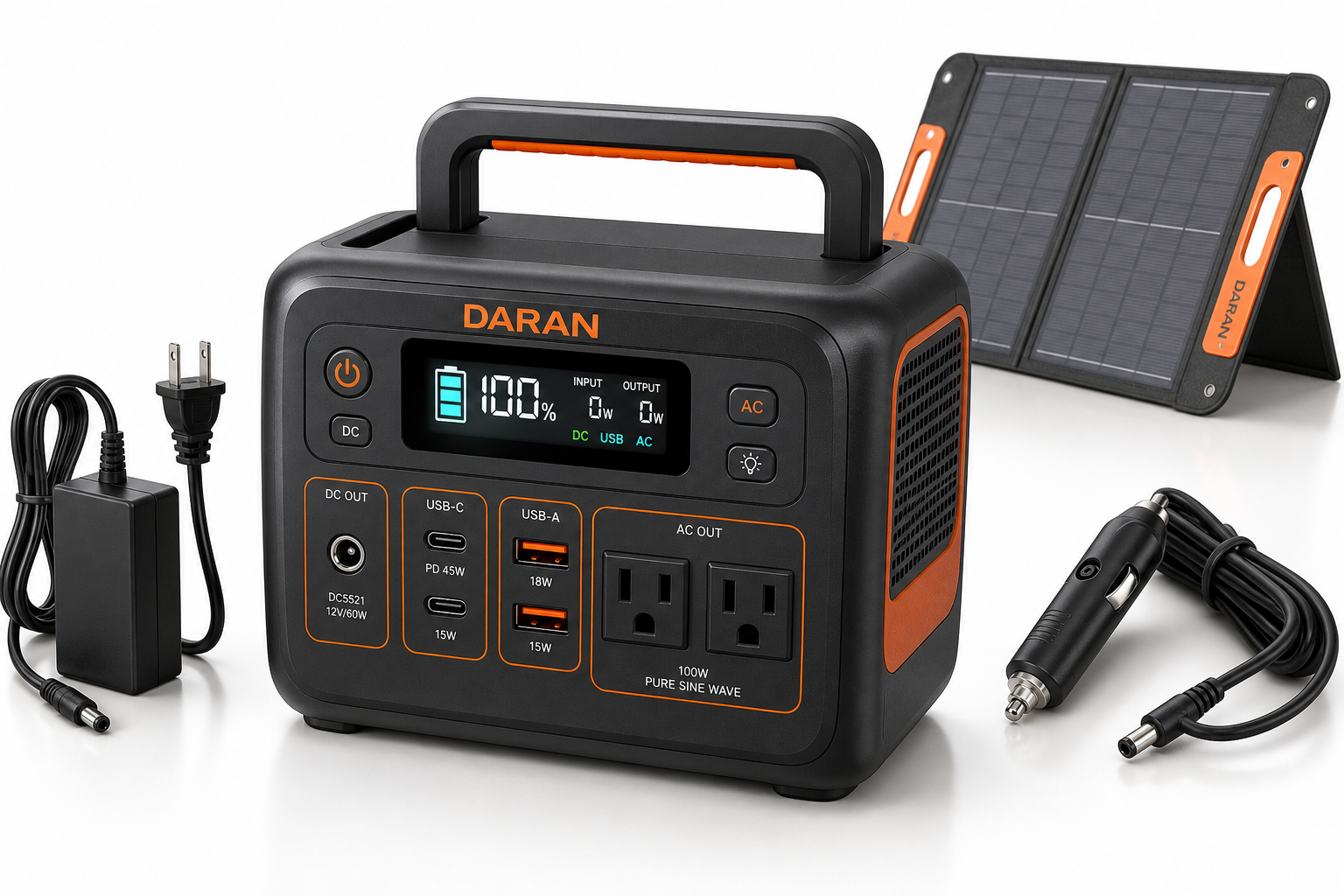
The DARAN Portable Power Station 89.6Wh LiFePO4 Battery 100W (200W Peak) is a compact AC-equipped power bank designed for light household backup, travel, and camping. Built around an 89.6Wh (28,000mAh) LiFePO4 battery, it delivers up to 100W continuous output (200W surge) via a pure sine wave inverter, making it suitable for sensitive electronics like laptops, cameras, and small projectors.
While it is far from a whole‑home backup solution, the DARAN unit aims to bridge the gap between a standard USB power bank and a bulkier power station. It adds AC outlets, multi‑port USB and DC outputs, and multiple charging methods, including optional solar input, in a chassis small enough to keep in a backpack or emergency kit.
If you are considering a compact emergency or travel power source and want LiFePO4 longevity rather than traditional lithium‑ion, this model is positioned as an affordable option at around $68.39 on Amazon.
Standout Features
1. LiFePO4 Battery Chemistry for Longevity
The core of this power station is its 89.6Wh LiFePO4 battery pack. LiFePO4 (lithium iron phosphate) chemistry is known for:
- Long cycle life: commonly rated for 3,000–3,500+ cycles before dropping to around 80% of original capacity.
- Improved thermal stability and safety compared with many NCM/NCA lithium packs.
- Flatter discharge curve, helping maintain usable voltage across the capacity range.
For a device that may sit in a closet for emergencies, be used seasonally for camping, or be cycled frequently as a laptop backup, this longer lifespan is a meaningful differentiator versus cheaper NCM-based mini power stations.
2. 100W Pure Sine Wave AC with 200W Surge
The unit provides 100W continuous (200W peak) pure sine wave AC output via dual AC outlets. This output level is well-tuned for:
- Ultrabooks and smaller laptops
- Tablets and phones
- Routers, modems, ONT units
- LED lighting and small fans
- Small projectors and low‑draw photo/AV gear
The pure sine waveform makes it safer for sensitive electronics than modified‑sine inverters often seen in low‑cost gear.
3. Seven Output Ports for Multi‑Device Charging
The DARAN power station includes seven outputs, allowing you to power or charge several devices at once:
- 2 × AC outlets (100W total, 200W surge)
- 2 × USB‑C ports (one higher‑power PD port reportedly up to 45W, plus a 15W port)
- 2 × USB‑A ports (up to 18W/15W for phones and accessories)
- 1 × DC5521 port (up to 60W) for compatible DC devices
This configuration is better thought out than many single‑AC mini stations. It supports a realistic combination like: one laptop on USB‑C PD, a phone and tablet via USB‑A, and a router or small fan on AC—all from a single compact unit, as long as total power stays within the 100W continuous rating.
4. Multiple Recharging Options, Including Optional Solar
For recharging, the power station supports several input methods:
- AC wall charging (fastest; often specified to ~80% in about 1.5 hours under ideal conditions)
- USB‑C PD input (two‑way PD for both charging the station and powering devices)
- 12V car charging for road trips and vehicle-based camping
- Solar panel input via DC (solar panel optional, not included)
This versatility means you are not tied to any single charging environment. For camping and off‑grid use, the optional solar support can extend runtime considerably, though the relatively modest 89.6Wh capacity means it is still best suited for light loads rather than full‑day high‑power usage.
5. Integrated Display and Compact Design
A built‑in LED display shows battery status and power information, helping users understand when they are approaching the system’s limits and when it is time to recharge. The overall form factor is designed to be small and lightweight enough for everyday carry or glove‑box storage, significantly smaller than typical 300–500Wh power stations.
Supporting Features
Beyond its main capabilities, the DARAN Portable Power Station includes several supporting features that round out its use cases:
- Quiet operation: With no traditional engine and a small inverter, it runs almost silently, which is ideal in tents, small apartments, or shared workspaces.
- Built‑in protections and BMS: Over‑voltage, over‑current, over‑temperature, and short‑circuit protection typically managed by an internal battery management system (BMS). This is especially important in compact, high‑density LiFePO4 packs.
- Emergency readiness: The combination of AC, DC, and USB outputs makes it useful during brief power outages—to power a router, charge phones, keep a small lamp on, or run a compact medical or communication device that remains within the power envelope.
- Digital status indicators: Users can see remaining charge at a glance, helping to plan usage during outages or long travel days.
Usability
Setup and Everyday Use
The DARAN power station is designed for straightforward, plug‑and‑play operation:
- Charge via wall outlet, USB‑C, car adapter, or compatible solar panel.
- Connect devices to AC, USB, or DC outputs.
- Turn on the AC inverter (typically via a dedicated button) when needed.
The interface is intentionally simple, which is an advantage for non‑technical users who only need reliable backup during occasional outages or travel.
Port Layout and Handling
The layout places AC outlets and DC ports on visible faces, minimizing cable clutter. The compact body and light weight make it easy to grab with one hand or slip into a backpack.
For home use, it can sit discreetly near a router or work desk. During camping, its small footprint suits tent corners or tabletop setups without dominating limited space.
Learning Curve and Safety
Users should be aware of a few practical limitations to avoid frustration or misuse:
- 100W continuous limit: This is enough for a laptop or small TV, but not for kettles, hair dryers, large gaming laptops under load, or space heaters.
- Shorter runtime for AC-heavy loads: Inverting DC battery power to AC introduces efficiency losses; continuous high AC draw will shorten usable runtime more than equivalent DC/USB loads.
Once users understand these boundaries, day‑to‑day operation is largely intuitive.
Performance
Capacity and Real‑World Runtime
At 89.6Wh, the DARAN power station’s capacity is modest but appropriate for its size class. Real‑world usable capacity will be somewhat lower than the rated figure due to inverter and conversion losses, especially for AC loads.
Approximate runtime examples (assuming typical efficiency and not exceeding 100W continuous):
- Wi‑Fi router and modem (~10–15W combined): Several hours of connectivity during an outage.
- Ultrabook laptop at light to moderate use (~30–45W via USB‑C PD): Roughly 1.5–2+ full work sessions, depending on screen brightness, CPU load, and whether the laptop’s internal battery helps share the load.
- LED lighting (~5–10W): Extended emergency or campsite lighting (multiple evenings if used sparingly).
- Phone charging: Multiple full smartphone charges, especially if you use USB‑C/USB‑A instead of AC.
Because of the small total capacity, this product is best used for short‑duration tasks, topping up devices, and bridging brief power gaps rather than for all‑day, multi‑appliance setups.
Recharging Performance
With fast AC or USB‑C input, the power station can typically recharge from low state of charge to around 80% in roughly 1.5 hours under optimal conditions. Full charges may take longer, and real‑world times depend on adapter wattage and ambient temperature.
Solar recharging is more variable and depends on panel wattage, sun intensity, and orientation. For a small 50–100W panel in good sun, topping up the 89.6Wh battery is realistic within a few hours, which pairs well with light‑duty camping or minimalist off‑grid setups.
Thermal and Acoustic Behavior
Thanks to LiFePO4 chemistry and the modest inverter power, thermal output is relatively low during typical use. The unit is nearly silent, with only minor fan noise when charging or under heavier load (if present at all). This makes it suitable for overnight use in quiet environments like bedrooms or tents.
Pros and Cons
Pros
- LiFePO4 battery chemistry for significantly longer cycle life and improved safety compared with many standard lithium‑ion power banks.
- Compact and lightweight design, making it easy to carry in backpacks or store in vehicles and emergency kits.
- 100W pure sine wave AC output with 200W surge, suitable for laptops, routers, small electronics, and sensitive devices.
- Seven total output ports, including dual AC outlets, USB‑C PD, USB‑A, and DC5521, supporting multiple devices simultaneously.
- Flexible recharging options: AC wall, USB‑C PD, 12V car, and optional solar panel input.
- Quiet, emission‑free operation, ideal for indoor use and small spaces.
- Clear digital display for monitoring battery level and status.
Cons
- Limited 89.6Wh capacity restricts runtime for power‑hungry devices or extended outages.
- 100W continuous output ceiling rules out many household appliances (e.g., kettles, hair dryers, gaming desktops, high‑brightness projectors, and most power tools).
- Solar panel not included, so off‑grid users must budget separately for a compatible panel.
- No large DC car outlet (cigarette lighter style) on some configurations, which might limit certain 12V accessories that rely on that connector type.
- Not a replacement for larger 300–500Wh class power stations if you need to run multiple or higher‑wattage loads for long periods.
Summary
The DARAN Portable Power Station 89.6Wh LiFePO4 Battery 100W (200W Peak) is best understood as a high‑end, AC‑capable power bank rather than a full‑scale generator replacement. Its strengths lie in LiFePO4 longevity, quiet operation, multiple ports, and flexible recharging options, including optional solar.
For users who need a compact backup to keep a laptop running through a meeting, maintain internet during short outages, charge devices on camping trips, or power small DC/AC gadgets on the go, it offers a compelling mix of portability and functionality at a price around $68.39.
If your priorities are lightweight design, long‑life battery chemistry, and multi‑port flexibility rather than high‑wattage output or multi‑day runtime, this DARAN unit is a strong candidate in the small power station category.