
Anker SOLIX C300 Portable Power Station Review: Compact 288Wh LiFePO4 Power for Camping and Emergencies
The Anker SOLIX C300 is a 288Wh, 300W portable power station built around long-lasting LiFePO4 cells and fast 140W USB-C charging. It targets users who need a compact and reliable power source for camping, short off-grid trips, and home emergencies. This review looks at its design, port selection, charging performance, real-world usage, key strengths and weaknesses, and the scenarios where the C300 makes the most sense.
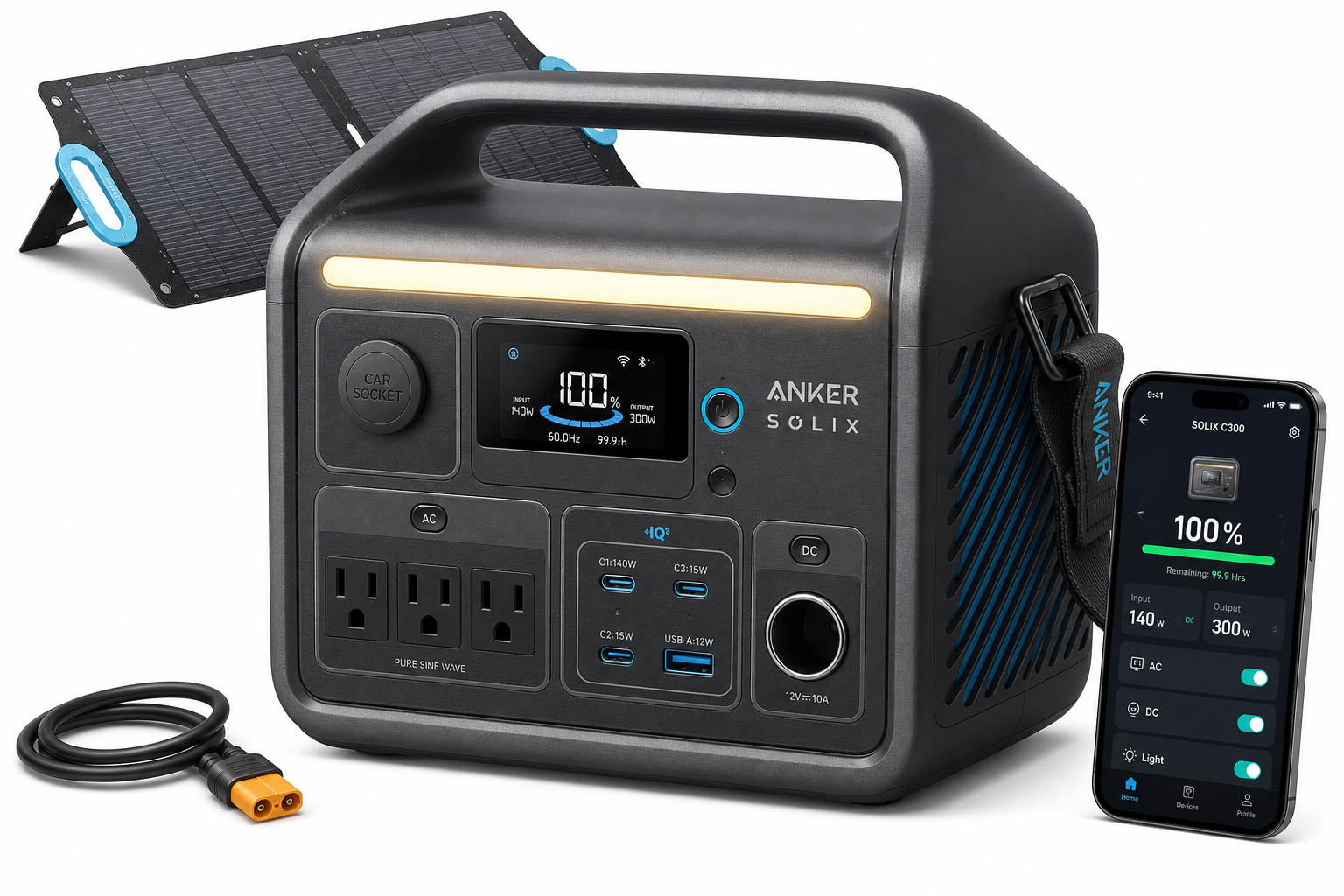
Overview
The Anker SOLIX C300 Portable Power Station is a compact 288Wh LiFePO4 unit with a 300W pure sine wave inverter (600W surge) and strong USB-C fast charging capabilities. It is positioned as an entry-level, highly portable power station for camping, short road trips, and household backup of small devices, with optional solar input for off-grid recharging. Anker combines a relatively small footprint with modern LiFePO4 chemistry designed for long life and a smart app-enabled control system.
From a value standpoint, it typically sits around $329.99 on Amazon, placing it in the competitive 200–300 Wh portable power category.
Key Highlights
- Battery & Chemistry: 288Wh LiFePO4 battery rated for long cycle life (around 3,000 cycles to 80% capacity in typical marketing and documentation).
- Output Power: 300W continuous AC output with up to 600W surge capability, suitable for small appliances and electronics. (manuals.plus)
- Port Selection (C300 AC model):
- 3 × AC outlets (pure sine wave)
- Multiple USB-C ports, including a 140W two-way USB-C port for both input and output
- 1 × USB-A port
- 1 × 12V car socket (120W input/output)
- Charging Options:
- Fast AC wall charging (Anker quotes roughly 50–70 minutes for a high-percentage recharge depending on input mode)
- 140W USB-C PD 3.1 two-way charging
- Solar charging via XT-60 input (up to around 100W with compatible panels)
- Car charging via the 12V socket with appropriate cable (youtube.com)
- Design & Portability: Compact, roughly 24 × 16 × 16 cm, with a solid handle and optional strap attachment. It is lighter and smaller than many similarly specced competitors, improving packability. (reddit.com)
- Smart Features: Bluetooth and Wi‑Fi connectivity with Anker’s app for monitoring, firmware updates, and mode settings, plus a built-in light bar/lantern and status display.
Core Features
1. Battery and Longevity
The SOLIX C300 uses LiFePO4 (LFP) cells, a chemistry known for high cycle life and thermal stability. Documentation and community specs consistently list:
- Capacity: 288Wh (90,000 mAh)
- Chemistry: LiFePO4
- Cycle Life: Around 3,000 full cycles before significant capacity loss is expected
In practical terms, this means the C300 is designed to withstand years of regular use—such as frequent camping trips, weekly backup duty, or daily partial cycling—before its capacity meaningfully degrades. (manuals.plus)
2. Inverter and AC Output
The unit provides a 300W continuous AC output, with a 600W surge rating for short startup loads, across three AC outlets. That makes it suitable for:
- Laptops, tablets, phones
- Small fans
- LED lighting
- Low-wattage projectors
- Some small kitchen devices (within the 300W limit)
It is not intended for high-draw tools, heaters, or large appliances. Users planning to run anything near the 300W ceiling for extended periods must account for relatively short runtime from a 288Wh pack (on the order of an hour at high continuous load, ignoring inverter losses).
3. Ports and Connectivity
The SOLIX C300 distinguishes itself with strong USB-C capabilities:
- 140W USB-C (two-way): Supports fast input and output under USB PD 3.1, letting you both charge the station quickly from a compatible charger and fast-charge laptops or other high-demand devices.
- Additional USB-C ports (including a 15W port for phones or accessories)
- 12W USB-A port for legacy devices
- 12V car socket (120W) for DC appliances and car charging
The optional variant C300 DC omits AC outlets entirely and focuses even more heavily on DC and USB output but is considered a separate model; the product linked here is the AC version with three outlets. (manuals.plus)
4. Charging Methods
Charging flexibility is a core feature:
- AC Wall Charging: Anker advertises roughly 50–70 minutes to reach a high state of charge (around 80% or more), depending on input configuration. In practice, reviewers see fast top‑ups that are convenient for last‑minute pre-trip prep.
- USB‑C PD Charging: The 140W two-way USB‑C port allows you to use high‑power laptop chargers or GaN bricks both to replenish the C300 and to draw power from it for demanding devices.
- Solar Charging: Compatible with Anker’s own 60W or 100W panels and third-party panels via XT‑60 (within the supported voltage range). This allows daytime topping-up while camping or during outages. (manuals.plus)
Usage Experience
Setup and Interface
Out of the box, setup is straightforward: plug it in to charge, connect devices to the desired outlets, and optionally pair it with the Anker app. The front display provides battery percentage, estimated remaining runtime or charge time, and per‑port status. Buttons are clear and logically grouped (AC, DC, and light controls), with separate toggles for AC and DC outputs.
The Anker app (via Bluetooth/Wi‑Fi) gives access to:
- Real‑time power flow and battery status
- Toggling ports and eco modes remotely
- Firmware update options
Noise and Thermal Behavior
The unit is designed to run relatively quietly, especially at light to moderate loads. Under higher load or fast charging, the cooling fan becomes audible but remains acceptable for most indoor use. Video reviewers and users generally rate noise as moderate to low for its class. (youtube.com)
Real‑World Scenarios
-
Camping & Overland Travel
Users report using the C300 to run camp lighting, charge phones and cameras, and power small fans or CPAP machines overnight. The 288Wh capacity, when matched with modest loads, provides a full night’s support without draining the pack. -
CPAP / Medical Devices (with appropriate settings and approvals)
Community experiences show that, with a CPAP drawing ~5–7W for around 8 hours, a 288Wh pack can handle multiple nights of sleep before needing a recharge, especially if humidifiers and heated tubing are disabled to reduce draw. (reddit.com) -
Home Backup for Electronics
It can serve as a small uninterruptible power supply (UPS)-like backup for routers, modems, and low‑power PCs or NAS units. Some users do report nuanced behavior depending on how devices handle the transfer and voltage thresholds, so compatibility may vary with sensitive hardware. (reddit.com) -
Office and Remote Work
Paired with a laptop and monitor under 300W combined, the C300 can provide several hours of off‑grid work time, particularly if loads are optimized and brightness is lowered.
Strengths
-
Long‑Life LiFePO4 Battery
Compared with older NMC‑based stations, the C300’s LiFePO4 cells are better suited to heavy cycling and long‑term ownership, a notable advantage if you plan daily or weekly use. -
Compact, Portable Design
The footprint and weight are competitive for a 288Wh class device. It is easier to pack than many 500Wh+ units, yet still provides enough energy for overnight essentials. -
Modern USB‑C Implementation
The 140W two-way USB‑C port enables single‑cable fast charging for many recent laptops, tablets, and phones. This is especially valuable for users who prefer to travel with fewer bricks and cables. (youtube.com) -
Flexible Charging Options
With AC, 140W USB‑C, car, and solar input, the C300 adapts to a variety of situations—from grid power to vehicle charging to off‑grid solar setups. -
App Connectivity and Usability
The companion app, combined with the clear front display and simple controls, makes monitoring and configuring the unit straightforward, even for newcomers to portable power stations. -
Thoughtful Extras
Features such as the integrated light bar/lantern and rapid top‑off from wall power add convenience during emergencies and outdoor trips.
Weaknesses
-
Limited Capacity for High‑Draw Loads
At 288Wh and 300W continuous, the C300 is best for small to mid‑size electronics. Running near the maximum 300W will deplete the battery quickly, so it is not ideal for sustained use of heaters, large power tools, or full‑size refrigerators. -
Not the Quietest Under Maximum Load
While relatively quiet at low loads, sustained heavy usage or rapid AC charging can bring the fan noise into a more noticeable range, which may bother noise‑sensitive users in small spaces. -
UPS Behavior Not Perfect for Every System
Reports indicate that while the C300 can act as a backup source for computers or NAS devices, behavior under brief outages or voltage drops may depend on how each device handles the switching timeframe and voltage thresholds. This makes it less of a plug‑and‑forget UPS than dedicated, line‑interactive UPS units in some setups. (reddit.com) -
Solar Input Power Is Modest
With around 100W supported via XT‑60, solar recharging is practical but not extremely fast. Cloudy conditions or low‑angle sun can significantly slow charge times, especially if heavily used daily. -
Price Positioning
Within the 200–300Wh class, the C300 often sits at a premium relative to some lesser‑known brands. The build quality, LiFePO4 cells, and strong USB‑C support justify much of that premium, but strictly budget‑focused buyers will find cheaper alternatives.
Suitable Scenarios
The Anker SOLIX C300 fits best in the following use cases:
-
Weekend Camping and Car Camping
Ideal for powering lights, phones, cameras, and a fan or two, plus optionally a CPAP, over a night or two. -
Short‑Term Emergency Backup at Home
Useful for keeping communication gear (phones, routers, modems), small radios, and low‑power medical or comfort devices running through short outages. -
Remote Work and Study
A strong companion for laptops, tablets, and portable monitors where AC access is intermittent, especially when paired with a 60–100W solar panel. -
Travel and Road Trips
The size makes it easy to keep in a trunk for powering coolers, infotainment, and charging devices during breaks or overnight stays. -
Entry‑Level Solar and Portable Power Learning
For users new to solar generators, the C300’s app, clear display, and modest solar input let you experiment with basic off‑grid setups without the complexity or cost of a large system.
Less‑suitable scenarios include powering energy‑hungry appliances (space heaters, full‑size fridges, hair dryers, or heavy power tools) or serving as a whole‑home backup—these require larger capacity and higher‑wattage units.
Final Evaluation
The Anker SOLIX C300 Portable Power Station is a well‑rounded, compact solution for users who prioritize portability, long‑life LiFePO4 chemistry, and strong USB‑C performance over raw capacity. Its 288Wh battery and 300W inverter comfortably cover small electronics, light camping duties, and short emergency backups, while the optional solar input and fast AC/USB‑C charging keep downtime low.
Buyers who mainly need to run very demanding appliances or who expect multi‑day autonomy without recharging should look toward larger-capacity models. However, for camping, travel, and everyday resilience in the face of brief outages, the SOLIX C300 offers a balanced mix of modern features, longevity, and ease of use at around $329.99.
For detailed specifications and current availability, consult the official product page:
- Anker Portable Power Station SOLIX C300 on Amazon: https://www.amazon.com/dp/B0D62GMQ3F