
Anker SOLIX C300 DC Review: Compact DC-Only Power for Travel, Camping, and Everyday Backup
The Anker SOLIX C300 DC is a compact 288Wh, 300W portable power station built around a long‑life LiFePO4 battery and a DC‑only output design. It targets users who rely primarily on USB‑C, USB‑A, and 12V devices rather than AC appliances, offering fast USB‑C charging, solar compatibility, app connectivity, and a highly portable form factor. This review looks at where the C300 DC excels—like powering laptops, cameras, networking gear, and CPAP machines—and where its limitations, such as the lack of AC outlets and some charger compatibility quirks, might make other models a better fit.
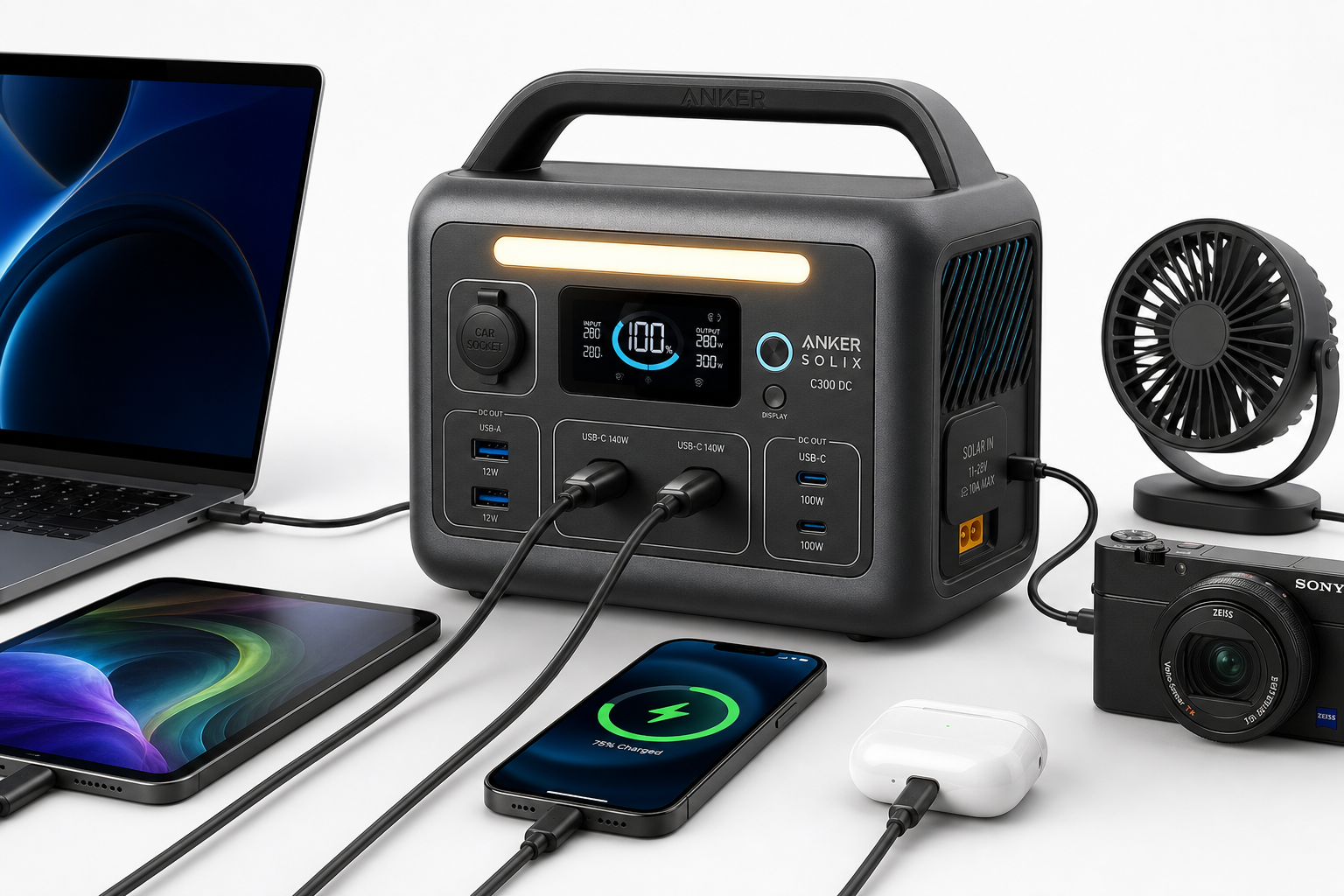
Product Summary
The Anker SOLIX C300 DC Portable Power Station is a 288Wh, 300W DC‑only power station designed for users who live primarily in the USB‑C and 12V world. Built around a LiFePO4 battery rated for thousands of cycles, it’s meant to deliver dependable power for camping, travel, and emergency backup without the bulk and conversion losses of an AC inverter.
Key specs and characteristics:
- Battery capacity: 288Wh LiFePO4 (approx. 85% usable in real‑world use)
- Output power: Up to 300W combined across all DC outputs
- Outputs (no AC outlets):
- 4 × USB‑C (including dual 140W USB‑C ports for high‑power devices)
- 2 × USB‑A ports for legacy devices
- 1 × 12V car socket (cigarette lighter style)
- Charging options:
- USB‑C input (up to ~280W combined with compatible PD 3.1 chargers)
- XT‑60 solar input (up to 100W with a compatible panel)
- Estimated recharge time: About 70 minutes from wall/USB‑C when using high‑power input
- Form factor: Compact, easy‑to‑carry housing with handle, digital display, retractable light, and Bluetooth/Wi‑Fi app control
On Amazon, the Anker SOLIX C300 DC typically sits in the compact power‑station price bracket around $199.99, which positions it against other 250–320Wh units that often include AC inverters. Instead of competing on raw flexibility, Anker leans into efficiency and modern DC power delivery.
Target Users
The C300 DC is best suited for users whose devices already run on USB‑C or 12V and who prioritize portability over running traditional AC appliances.
Ideal users include:
-
Digital nomads and remote workers
- Charging laptops, tablets, phones, and cameras throughout a workday.
- Running small networking gear such as a travel router or mobile hotspot.
-
Campers, van‑lifers, and overlanders
- Powering 12V coolers, lights, fans, action‑camera batteries, and navigation devices.
- Topping up multiple phones and tablets for a group.
-
CPAP and medical device users (with DC options)
- Users who can run a CPAP or similar device via 12V DC or dedicated DC cables rather than AC.
-
Home users wanting a compact backup source
- Keeping phones, power banks, flashlights, small routers, and modems running in short outages.
-
Tech‑forward users invested in USB‑C PD
- Owners of USB‑C laptops that support high‑wattage PD (100W+), who want to maximize efficiency and avoid the overhead of AC conversion.
If you frequently need to run AC devices like kettles, coffee makers, desktop PCs, or large monitors, a different Anker SOLIX model with AC outlets—or a competitor with an integrated inverter—will be a better match.
Main Benefits
1. DC‑Only Design for Efficiency and Size
By omitting an AC inverter, the C300 DC:
- Reduces conversion losses, which can be significant when going from DC battery → AC → back to DC inside laptop/phone chargers.
- Keeps the unit smaller and lighter than many 300W‑class power stations.
- Improves runtime for DC‑native loads, especially when you use USB‑C PD or 12V outputs directly.
For users whose entire kit is already DC‑powered, this design is more streamlined than paying for an inverter you rarely use.
2. Strong USB‑C Implementation
The four USB‑C ports—particularly the dual 140W‑capable ports—support fast charging of:
- Modern laptops (USB‑C MacBook, many Windows ultrabooks, some gaming laptops under 140W)
- Tablets and phones with high‑speed PD charging
- High‑draw accessories like USB‑C monitors or docking stations, within the 300W total limit
Having multiple high‑power USB‑C ports is a standout advantage for multi‑device workflows.
3. Long‑Life LiFePO4 Battery
LiFePO4 chemistry typically offers around 3,000 cycles to 80% capacity (and often more in practice under gentle use). That means:
- Better long‑term value if you cycle the unit frequently.
- More predictable performance over several years compared with many NMC‑based power stations.
4. Fast Recharging and Solar Support
With compatible high‑power USB‑C chargers, the C300 DC can:
- Recharge from low to full in roughly around an hour when you feed it near its 280W input ceiling.
- Accept up to 100W solar via XT‑60, which is enough to refill a 288Wh pack during a sunny day, useful for camping and off‑grid setups.
This combination makes it suitable for both quick top‑ups at home and slower off‑grid recharging.
5. Compact, Portable, and App‑Connected
- Small footprint and integrated handle make it easy to carry compared to larger 500–1000Wh stations.
- Retractable light and clear digital display add practical, real‑world usability.
- Bluetooth/Wi‑Fi plus Anker app support lets you monitor remaining capacity, control outputs, and update firmware without having to be right next to the unit.
Key Considerations
Before choosing the Anker SOLIX C300 DC, keep the following in mind:
1. No AC Outlets
The most important limitation is the complete lack of AC ports:
- You cannot plug in traditional 120V AC appliances directly.
- Any device requiring a wall‑plug power brick must either be:
- Replaced with a USB‑C PD/12V version, or
- Powered via its own DC adapter (if available).
If your kit still relies heavily on AC, another model with AC outlets (such as the standard C300 variant) will be more flexible.
2. Charger Compatibility and USB‑PD Behavior
Because high‑wattage charging relies on USB‑PD 3.1 negotiation:
- Some users report that older or non‑standard PD chargers may not deliver more than low‑wattage input to the C300 DC.
- To get closer to the rated fast‑charge times, you should use modern, high‑output PD 3.1 USB‑C chargers or Anker’s own recommended adapters.
If you plan to reuse existing chargers, expect that not all of them will reach the maximum input power.
3. 288Wh Capacity and 300W Output Ceiling
- 288Wh is enough for small to medium loads—phones, laptops, routers, fans, and DC coolers—but not ideal for power‑hungry appliances.
- The 300W total output cap means high‑wattage gear (heaters, large gaming laptops under full load, some mini‑PCs or large monitors) may be constrained or may not start properly.
For light to moderate use, the capacity is appropriate; for power‑intensive scenarios, consider a higher‑capacity unit.
4. No Included Wall Charger
As noted in the product name, no dedicated wall charger is included in the box:
- You must supply your own compatible USB‑C PD charger or rely on solar and other DC sources.
- This keeps the package smaller and can save cost if you already own a high‑power USB‑C brick, but it’s an extra purchase for some buyers.
When budgeting, factor in the potential cost of a suitable PD charger in addition to the base price of $199.99.
Pros
- Efficient DC‑first design with no inverter overhead for USB‑C and 12V devices.
- Four USB‑C ports, including dual 140W‑capable ports for high‑demand laptops and accessories.
- LiFePO4 battery chemistry with long cycle life and better long‑term value.
- Compact and lightweight relative to many 300W‑class power stations.
- Multiple DC outputs (USB‑C, USB‑A, 12V car socket) for flexible, modern charging setups.
- Fast recharge potential via high‑wattage USB‑C and solar input.
- App connectivity (Bluetooth/Wi‑Fi) for monitoring, settings, and firmware updates.
- Integrated lighting and clear display for practical field use.
Cons
- No AC outlets, limiting compatibility with legacy and household appliances.
- Requires compatible USB‑C PD 3.1 chargers to realize full input performance; some existing chargers may only charge slowly.
- 288Wh capacity may be limiting for heavy power users or multi‑day, high‑draw trips.
- No included wall charger, which can add to the effective cost if you don’t already own one.
- Total 300W output cap restricts use with very high‑draw devices.
Alternatives
If you like the concept but need something slightly different, consider the following alternative directions. These are not detailed reviews, but they highlight where another class of product might be preferable.
1. Anker SOLIX C300 (Standard Version)
- Who it’s for: Users who want similar capacity and brand ecosystem, but also need AC outlets.
- Why consider it:
- Same 288Wh LiFePO4 foundation in a compact chassis.
- Adds AC sockets (around 300W continuous, higher surge) for small appliances.
- Typically costs more than the DC‑only version, but provides greater flexibility.
2. Competing 300W‑Class Portable Power Stations
Several competing brands offer power stations in the 250–320Wh, ~300–600W class:
- Pros vs C300 DC:
- Often include one or more AC outlets, making them more versatile for mixed DC/AC loads.
- Some offer slightly higher output power (for example, up to 600W AC) at similar capacities.
- Cons vs C300 DC:
- Usually larger and heavier due to integrated inverters.
- May use NMC batteries with shorter cycle life.
- Might have fewer high‑power USB‑C ports.
When comparing, pay close attention to:
- Battery chemistry and cycle life
- Number and capability of USB‑C ports
- AC vs DC needs in your own kit
3. Larger 500–1000Wh Power Stations
If your primary need is longer runtime or you plan to run power‑hungry devices:
- A larger‑capacity station (often with AC output) will offer significantly longer runtimes and higher continuous power limits.
- The trade‑offs are higher price, more weight, and less packability.
These are better suited for extended off‑grid stays, multi‑day emergency preparedness, or small appliance use.
Conclusion
The Anker SOLIX C300 DC Portable Power Station is a focused, DC‑only solution tailored to modern USB‑C and 12V workflows. Its 288Wh LiFePO4 battery, 300W combined output, strong USB‑C implementation, and fast‑charging/sun‑charging options make it an appealing choice for travelers, campers, and everyday users who no longer rely heavily on AC power.
Its biggest strengths—efficiency, portability, long cycle life, and multiple high‑power USB‑C ports—come with equally clear trade‑offs: no AC outlets, a modest 300W ceiling, and reliance on compatible PD 3.1 chargers for fast recharging. For buyers whose gear is already DC‑centric, these trade‑offs make sense, and the C300 DC offers a compact, well‑thought‑out package at around $199.99. If you still depend on AC appliances or need significantly more capacity, you’ll be better served by the standard C300 or a larger mixed‑output station; but if you’re firmly in the USB‑C era, the C300 DC is a compelling, efficient way to bring reliable power wherever you go.