
SOARAISE Solar Power Bank 48000mAh Review: A High‑Capacity, Feature‑Rich Outdoor Charger
This review examines the SOARAISE Solar Power Bank 48000mAh Wireless Portable Charger with 4 Cables and 4 Solar Panels, focusing on its ultra‑high capacity battery, multi‑device charging options (including wireless charging), rugged outdoor‑ready design, and suitability for camping and travel. Key points include charging performance, solar panel effectiveness, build quality, real‑world portability, strengths such as integrated cables and flashlight modes, and trade‑offs like charging speed via solar and the unit’s bulk. The article concludes with a value‑oriented assessment and recommendations on who will benefit most from this solar charger.
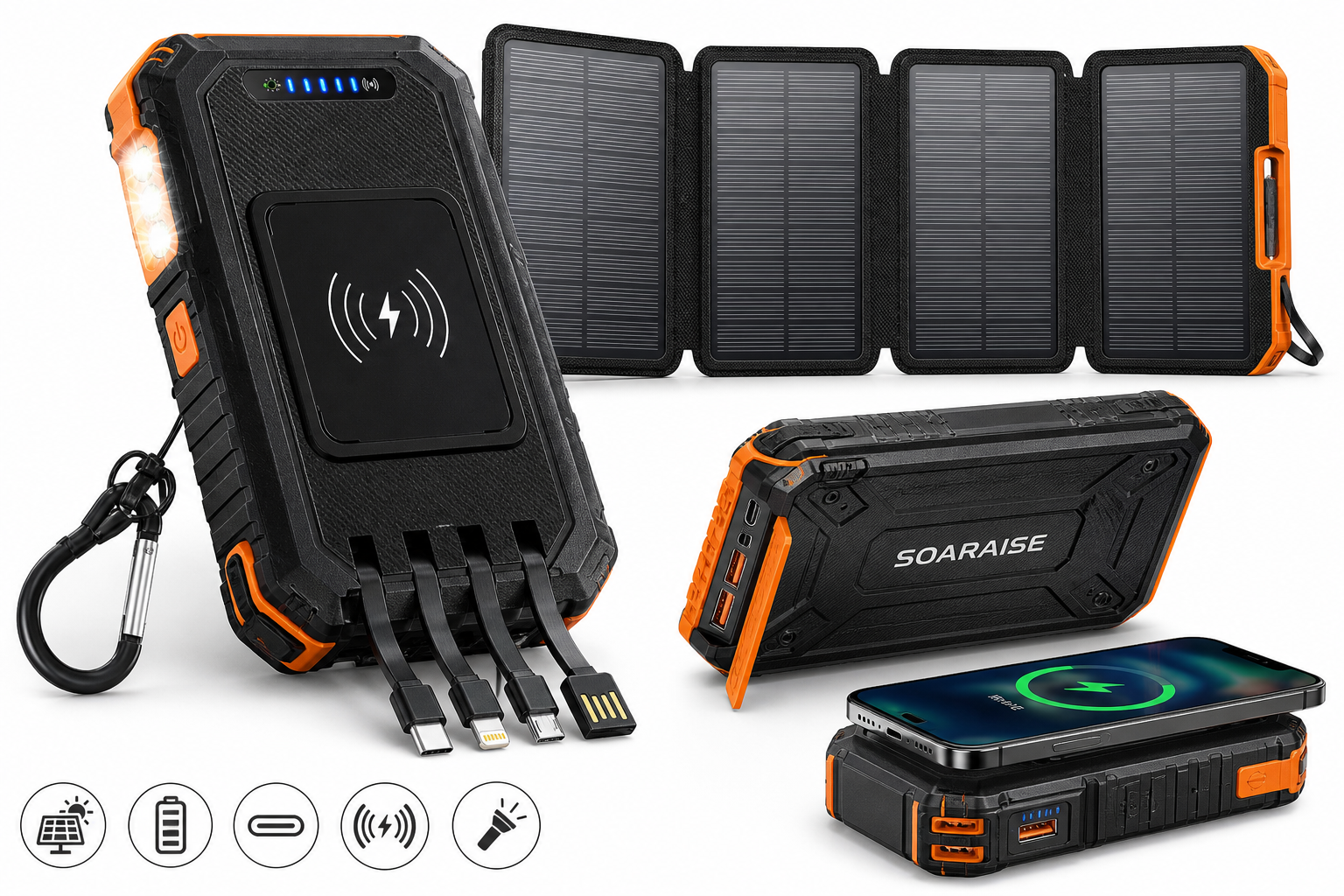
Quick Summary
The SOARAISE Solar Power Bank 48000mAh Wireless Portable Charger with 4 Cables is a high‑capacity, outdoor‑oriented battery pack that combines four foldable solar panels, multiple built‑in cables, USB‑C PD/QC 3.0 fast charging, wireless charging, and a multi‑mode flashlight in a single rugged unit. Designed for camping, hiking, emergencies, and extended travel, it aims to reduce cable clutter and keep multiple devices powered when wall outlets are scarce.
With a rated 48000mAh lithium‑polymer battery, support for up to 7 devices at once, and waterproof, shockproof, and dustproof construction, this model targets users who prioritize capacity and versatility over compactness. However, like most compact solar power banks, its solar input is best treated as a supplemental charging method rather than a primary power source.
Detailed Analysis
Design and Build Quality
The SOARAISE unit is built around a brick‑style main body with four foldable solar panels that open like a book. When folded, the device is similar in footprint to a thick smartphone but considerably heavier and bulkier due to the large battery and additional panels. Unfolded, the panels provide a much greater surface area than typical single‑panel solar power banks, improving practical solar intake.
Key design characteristics:
- Rugged housing: The outer shell is advertised as waterproof, shockproof, and dustproof, making it suitable for outdoor environments such as campsites, trails, and beaches.
- Four solar panels: Compared with single‑panel designs, the four‑panel array can charge the internal battery several times faster under ideal sunlight, though it still cannot match the speed of wall charging.
- Integrated LED flashlight: The unit includes a multi‑mode LED light (typically Standard, SOS, and Strobe), which is useful in tents, power outages, or roadside emergencies.
- Bright accent color (often orange): The contrasting trim improves visibility in grass, dirt, or inside a packed backpack.
Overall, the physical construction prioritizes durability and outdoor practicality over minimal weight.
Capacity and Battery Technology
The standout specification is the 48000mAh battery capacity. In practical terms, this capacity is designed to offer multiple charges for smartphones and significant top‑ups for tablets and other USB‑powered gear before the bank itself needs recharging.
The pack uses a lithium‑polymer battery rather than cylindrical cells. Lithium‑polymer packs allow a flatter form factor and can offer an improved cycle life when properly managed. The manufacturer also highlights an extended lifespan compared with some conventional cells, which is relevant for users planning frequent, long‑term use.
While real‑world usable capacity is always lower than the rated figure (due to conversion losses and varying device voltages), the SOARAISE power bank still falls into the ultra‑high‑capacity class and is intended to support multi‑day trips away from mains power.
Charging Interfaces and Outputs
One of the defining features of this model is its unusually flexible I/O configuration:
- Ports
- 2 × USB‑A outputs – for standard wired charging.
- 1 × USB‑C port – serving as both input and output, with support for PD/QC 3.0 fast charging up to about 3A.
- Built‑in cables (4 total)
- USB‑C cable.
- Lightning (iOS) cable.
- Micro‑USB cable.
- USB‑A cable (for use as either an input to charge the bank or an output to charge other devices, depending on configuration).
- Wireless charging pad
- A Qi‑compatible wireless charging area on the body for cable‑free phone charging.
This setup allows the power bank to support a claimed seven simultaneous outputs (wired plus wireless) when necessary. In real usage, that makes it a compact charging hub for groups, or for a single user carrying a phone, tablet, camera, and other accessories.
Wired and Wireless Charging Performance
Through its USB‑C PD/QC 3.0–capable port, the SOARAISE bank can deliver up to 3A at 5V to compatible devices. Under typical conditions, this is sufficient for fast charging many smartphones and smaller tablets. The vendor explicitly notes time savings such as taking a smartphone from a low state of charge to a significantly higher level in under an hour when using the high‑current USB‑C output.
Wireless charging is integrated on the top surface. You simply place a Qi‑compatible phone—such as recent iPhone or Galaxy models—on the pad to begin charging. Wireless output power is lower than peak wired PD, so it is best treated as a convenient, cable‑free option rather than the fastest way to refill your device.
Solar Charging Capabilities
The four foldable solar panels are a major selling point. Compared to single‑panel solar banks, the SOARAISE unit can achieve much higher solar input power under full sun. This allows:
- Faster partial recharges during long days outdoors.
- More meaningful energy recovery on extended trips without access to mains power.
However, it is important to set realistic expectations:
- Solar charging is weather‑dependent. Cloud cover, shading, and sub‑optimal angles can dramatically limit the effective power output.
- Full recharges from solar alone are time‑consuming. Even with four panels, completely filling a large 48000mAh pack from solar usually requires strong, sustained sunlight over many hours across multiple days.
In practice, the solar feature works best as a top‑off mechanism, stretching the intervals between plug‑in charges rather than fully replacing wall power.
Durability and Outdoor Readiness
For outdoor applications, durability often matters more than sleek aesthetics. The SOARAISE bank emphasizes:
- Water resistance – protection against splashes and light rain.
- Shock resistance – rugged casing designed to handle minor drops or bumps in a backpack.
- Dust resistance – sealed seams and port covers help keep debris out.
These attributes, together with the built‑in flashlight and solar panels, position the device as a multi‑purpose tool for camping, hiking, fishing trips, road trips, and emergency preparedness kits.
User Experience
Setup and Everyday Use
Out of the box, the user experience is straightforward:
- Pre‑charge via USB‑C or Micro‑USB using an existing charger.
- Connect devices using either the built‑in cables or your own USB‑A/USB‑C cables.
- Place the pack in sunlight with panels unfolded when you want to supplement charge via solar.
- Use the side button(s) to control the flashlight and sometimes to initiate certain charging modes, depending on the firmware.
The built‑in cables significantly reduce cable clutter. Travelers can often leave several separate cords at home, especially if all of their gear uses USB‑C, Lightning, or Micro‑USB.
Portability and Weight
The trade‑off for high capacity and four panels is bulk. Although still portable, the SOARAISE power bank is:
- Thicker and heavier than a standard 10,000–20,000mAh power bank.
- Better suited to backpacks, luggage, or vehicle glove compartments than to front jeans pockets.
For ultralight hikers counting every gram, this may be more weight than desired. For car campers, van lifers, family trips, and emergency kits, the size is usually acceptable given the large capacity.
Reliability and Charging Behavior
Real‑world usage patterns reported for similar high‑capacity solar banks suggest:
- Stable performance over multiple charge/discharge cycles when not routinely fully drained.
- Predictable wired charging speeds that align with PD/QC‑class expectations.
- Noticeable, but still relatively slow, top‑ups from solar over the course of a sunny day.
Users should expect best results by keeping the bank as topped up as possible from wall power before trips, then using solar as a backup and extender.
Pros
- Very high capacity (48000mAh) designed for multi‑day use without mains power.
- Four foldable solar panels for significantly improved solar intake versus single‑panel designs.
- Multiple charging options: USB‑A, USB‑C PD/QC, and Qi wireless charging.
- Four built‑in cables (USB‑C, Lightning, Micro‑USB, USB‑A) reduce the need to carry extra cords.
- Supports many devices at once with up to seven outputs, convenient for families or group trips.
- Ruggedized housing with water, shock, and dust resistance suitable for outdoor and emergency use.
- Integrated LED flashlight with helpful modes (e.g., Standard, SOS, Strobe) for night use.
- Broad device compatibility, from iPhones and Android phones to tablets, cameras, MP3 players, and other USB gadgets.
Cons
- Bulky and relatively heavy compared with low‑capacity or non‑solar power banks; not ideal for minimalist everyday pocket carry.
- Solar charging remains slow compared to wall charging, even with four panels; full solar recharges of the huge battery require extended, strong sunlight.
- Multiple moving parts (fold‑out panels and built‑in cables) may require more careful handling over time to avoid wear or damage.
- Wireless charging efficiency is lower than wired fast charging, so it is more about convenience than speed.
- High capacity means longer recharge times from wall power, especially with low‑wattage chargers.
Value Assessment
The SOARAISE Solar Power Bank 48000mAh Wireless Portable Charger with 4 Cables is engineered for users who prioritize capacity, versatility, and outdoor readiness over compact size. It effectively consolidates several accessories into one device:
- A large‑capacity power bank.
- A multi‑port charging hub.
- A solar charger.
- An emergency flashlight.
For individuals or families who regularly camp, travel off‑grid, or prepare for power outages, the combination of features can justify the added size and weight. It is especially attractive if you:
- Need to charge multiple devices at once.
- Want integrated cables to simplify your travel kit.
- Value solar as a backup to stretch time between plug‑in charges.
If your primary use case is light, everyday commuting or minimal travel with easy access to outlets, a smaller, lighter non‑solar power bank may be more convenient.
Final Thoughts
The SOARAISE Solar Power Bank 48000mAh Wireless Portable Charger with 4 Cables and 4 Solar Panels stands out as a feature‑rich, ultra‑high‑capacity power solution tailored to outdoor enthusiasts and preparedness‑minded users. Its combination of four solar panels, integrated cables, PD/QC 3.0 USB‑C fast charging, wireless charging, and rugged construction makes it a strong candidate for campers, road‑trippers, and anyone who wants a robust backup power source at home.
While it is not the lightest or smallest option, and solar remains best used as a supplementary charging method, the overall package is compelling if you value endurance, flexibility, and independence from the grid. For those scenarios, this SOARAISE model offers a well‑rounded, practical balance of features and performance.