
Portable Solar Generator 300W Review: Compact Off‑Grid Power with Included 60W Solar Panel
This review takes a close look at the 300W Portable Solar Generator bundle that combines a 280Wh portable power station with a foldable 60W solar panel. It evaluates build quality, real‑world capacity, charging options, and suitability for camping, RV use, van life, and emergency backup at home. The article highlights where the unit performs best, what types of devices it can realistically support, and the main trade‑offs to consider against more premium or higher‑capacity alternatives.
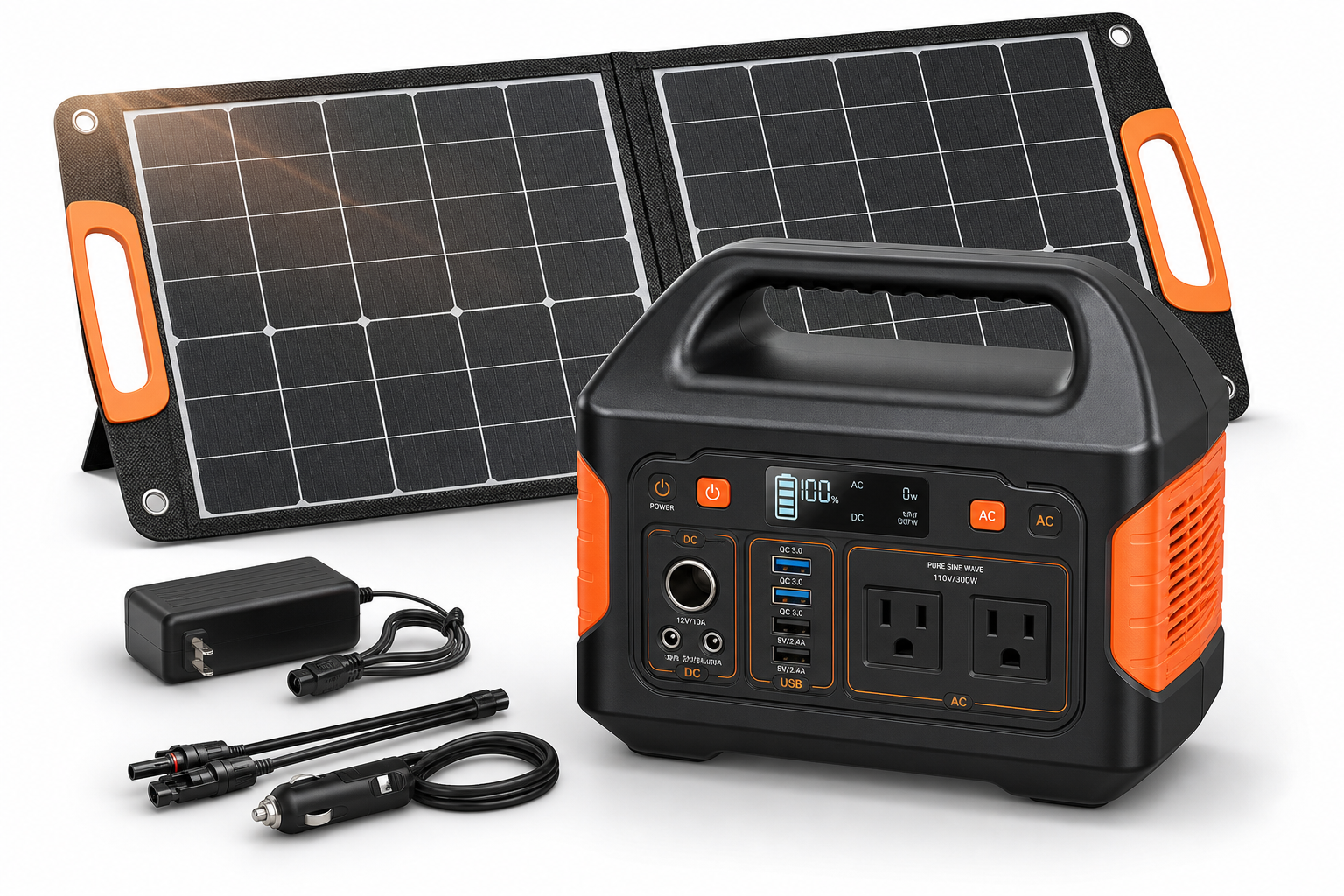
Product Summary
The Portable Solar Generator 300W Portable Power Station with 60W Solar Panel is an all‑in‑one entry‑level solar power kit. It pairs a roughly 280Wh lithium battery with a 300W pure sine wave inverter and a foldable 60W solar panel. The station offers AC outlets, DC ports, and USB (including QC3.0) to keep small electronics, lights, and low‑draw appliances running during camping trips, RV weekends, van travel, or short power outages.
For buyers who want a simple grab‑and‑go solution rather than piecing together a separate power station and solar panel, this bundle delivers a straightforward way to get started with portable solar at around $189.97.
Target Users
This 300W solar generator bundle is best suited for:
- Casual campers and weekend travelers who need to keep phones, cameras, lanterns, and maybe a mini fan or low‑wattage laptop powered overnight.
- RV and van owners looking for a secondary power source for light loads or as a backup to their main house battery system.
- Home users preparing for short blackouts, who mainly want to run communication devices, LED lights, a Wi‑Fi router, or charge power banks.
- Outdoor hobbyists (photography, fishing, tailgating, picnics) who need a compact, fairly quiet source of AC and DC power away from the grid.
It is not designed to serve as a whole‑home backup or to support heavy‑duty loads such as space heaters, hair dryers, large coffee makers, or power tools.
Main Benefits
1. All‑in‑One Kit (Power Station + 60W Solar Panel)
Getting both a 300W power station and a matching 60W solar panel in one package removes guesswork about compatibility. The included panel is sized to recharge the 280Wh battery over the course of a sunny day, which makes the kit self‑contained for typical camping or weekend use.
2. Pure Sine Wave 110V AC Output
The unit provides 110V pure sine wave AC, which is gentler on sensitive electronics than modified sine wave inverters. This matters if you plan to power devices like laptops, camera chargers, some medical devices rated for portable use, or small fans and pumps that can be picky about power quality.
3. Versatile Ports and Charging Options
While exact port counts vary by production run, this class of 300W stations typically includes:
- AC outlets (110V) for small appliances and adapters
- DC barrel outputs / car socket for 12V devices
- USB‑A ports with QC3.0 for fast charging compatible phones and gadgets
- Possibly USB‑C (PD) on some variants, allowing for higher‑power laptop charging
Charging the power station itself is usually possible via:
- Wall charger (AC adapter)
- 12V car socket
- Included 60W solar panel
This flexibility means you can top the unit up at home, in a vehicle, or off‑grid with solar.
4. Portable, Compact Design
The station’s footprint and weight are in line with other ~280Wh units: compact enough to stash in a car trunk or RV cabinet and light enough to carry with one hand. The orange colorway improves visibility in a cluttered van or tent and makes the device easier to spot in low light.
5. Quiet Operation and Zero Emissions
Unlike gas generators, this solar generator is silent in use (aside from a small cooling fan when under heavy load) and produces no fumes. That makes it practical for use inside tents, RV interiors, or small rooms during outages—useful for powering communications gear and lights without dealing with fuel or noise.
Key Considerations
1. Real‑World Capacity vs. Expectations
With a rated capacity around 280Wh, you should treat that as a theoretical maximum. In real use, inverter and conversion losses mean you’ll typically see 70–85% usable capacity.
Approximate use‑case examples (under ideal conditions):
- Smartphone (10–15Wh per full charge): 12–18 recharges
- Small laptop (40–60Wh): 3–5 recharges
- LED camping lantern (5W): around 35–45 hours
- Mini 30W fan: roughly 6–8 hours of runtime
Anything with higher continuous draw (e.g., 150–250W) will run for only a couple of hours, and appliances over 300W should not be connected at all.
2. Solar Recharging Speed
The bundled 60W solar panel is a reasonable match for a 280Wh battery, but keep expectations realistic:
- In strong sun, you might see 40–50W actual charging power after losses.
- A near‑empty 280Wh battery could take 6–8 hours of good sunlight to fully recharge.
This means the kit works well for daily top‑ups on multi‑day trips, as long as you’re mostly running small devices and you’re mindful of power use. If you’re in shade, cloudy conditions, or running higher loads, you may need to supplement with wall charging whenever you can.
3. Output Limitations
The 300W continuous / ~600W surge inverter rating is fine for phones, laptops, lights, and many small electronics, but there are notable limits:
- No high‑wattage appliances: Avoid devices like kettles, toasters, hair dryers, large coffee machines, electric heaters, or large power tools—they either won’t start or will quickly trip overload protection.
- Short‑duration spikes: Some devices (small compressors, pumps, or older electronics) may momentarily exceed the surge rating when starting up. Always check your device labels and leave headroom below 300W.
4. Battery Chemistry and Lifespan
This generator uses a standard lithium‑ion (NMC) battery, not LiFePO₄. The advantages are lower cost and lower weight, but the trade‑offs are:
- Fewer charge cycles before noticeable capacity loss compared with LiFePO₄ packs.
- More sensitivity to high temperatures—it’s important not to leave the unit in hot cars or in direct sun for extended periods.
For occasional camping and emergency use, this is usually acceptable, but heavy daily users may prefer a LiFePO₄‑based station.
5. Build Quality and Warranty Expectations
As a budget‑friendly bundle, materials and fit‑and‑finish are typically functional rather than premium. The housing is usually ABS + PC plastic with integrated handle and basic rubber feet. Expect adequate durability for normal travel and campsite use, but treat it more like consumer electronics than a rugged tool—avoid drops, heavy impacts, and prolonged moisture exposure.
Pros
- Complete starter kit: Power station plus a matched 60W foldable solar panel, so you can start using solar immediately without extra purchases.
- Pure sine wave inverter: Safer for laptops and sensitive electronics than modified sine wave units.
- Versatile outputs: Mix of AC, DC, and USB/QC3.0 ports for phones, tablets, lights, fans, and small appliances.
- Reasonably portable: Compact footprint, integrated handle, and foldable panel make it easy to transport and store.
- Quiet and emission‑free: Suitable for indoor use, tents, and RVs when used with proper ventilation and within rating.
- Value‑oriented pricing: Bundled kit is typically more economical than buying a separate 300W station and 60W panel, especially around $189.97.
Cons
- Limited capacity (≈280Wh): Best for light loads and short trips; not enough for large appliances or extended off‑grid living.
- Standard lithium‑ion battery: Shorter lifecycle and more temperature‑sensitive than LiFePO₄‑based competitors.
- Modest solar input: 60W panel is fine for topping up but will recharge slowly if the battery is heavily used each day.
- Output constraints: 300W continuous limit rules out many kitchen appliances and power tools.
- Basic construction: Housing and connectors are serviceable but may not match the ruggedness of higher‑priced brands.
Alternatives
If you’re considering this product, it’s worth thinking about how you’ll actually use it and whether an alternative format would fit better:
- Higher‑capacity stations (500–1000Wh) – If you want to power devices like mini‑fridges, CPAP machines for multi‑night use, or multiple laptops and lights simultaneously, a larger power station with 500Wh or more will offer much longer runtimes, though at significantly higher cost and weight.
- LiFePO₄‑based 300W stations – Some newer 300W class units use LiFePO₄ cells, offering longer cycle life and better thermal stability. You’d likely buy the solar panel separately, but it may be worthwhile for heavy or frequent use.
- Standalone power station + panel mix‑and‑match – If you already own a compatible 12–24V solar panel, you might opt for a standalone 300W station. Conversely, if you own a power station, you might only need a folding panel rather than a full kit.
These alternatives tend to cost more than this bundle, which is positioned clearly as a budget‑friendly, entry‑level option.
Conclusion
The Portable Solar Generator 300W Portable Power Station with 60W Solar Panel is a practical starter kit for users who want a simple, integrated way to bring solar power to camping trips, RV weekends, van outings, or short‑duration home outages.
Its strengths lie in ease of use, versatile outputs, and a balanced pairing of a 280Wh battery with a 60W panel, all at a wallet‑friendly price point represented here as $189.97. In return for that value, you accept some limitations: modest capacity, a 300W output ceiling, and a standard lithium‑ion battery rather than long‑life LiFePO₄.
If your primary goals are to keep phones, tablets, cameras, lights, and perhaps a small laptop or fan running off‑grid, this bundle offers a convenient, relatively low‑cost solution. If you anticipate heavier or more frequent use, or need to power higher‑wattage appliances, stepping up to a higher‑capacity or LiFePO₄‑based system will be the better long‑term fit.