
Jackery Explorer 300 Portable Power Station Review: Compact Backup Power for Camping and Blackouts
The Jackery Explorer 300 Portable Power Station is a compact 292–293Wh unit designed for camping, travel, and short-term home backup. With a 300W pure sine wave inverter, multiple output ports, and optional solar charging, it provides enough power for phones, laptops, cameras, small appliances, and networking gear during outages. This review covers the key features, performance characteristics, ideal use cases, trade-offs around battery chemistry and capacity, and how it compares to alternative small portable power stations.
Product Summary
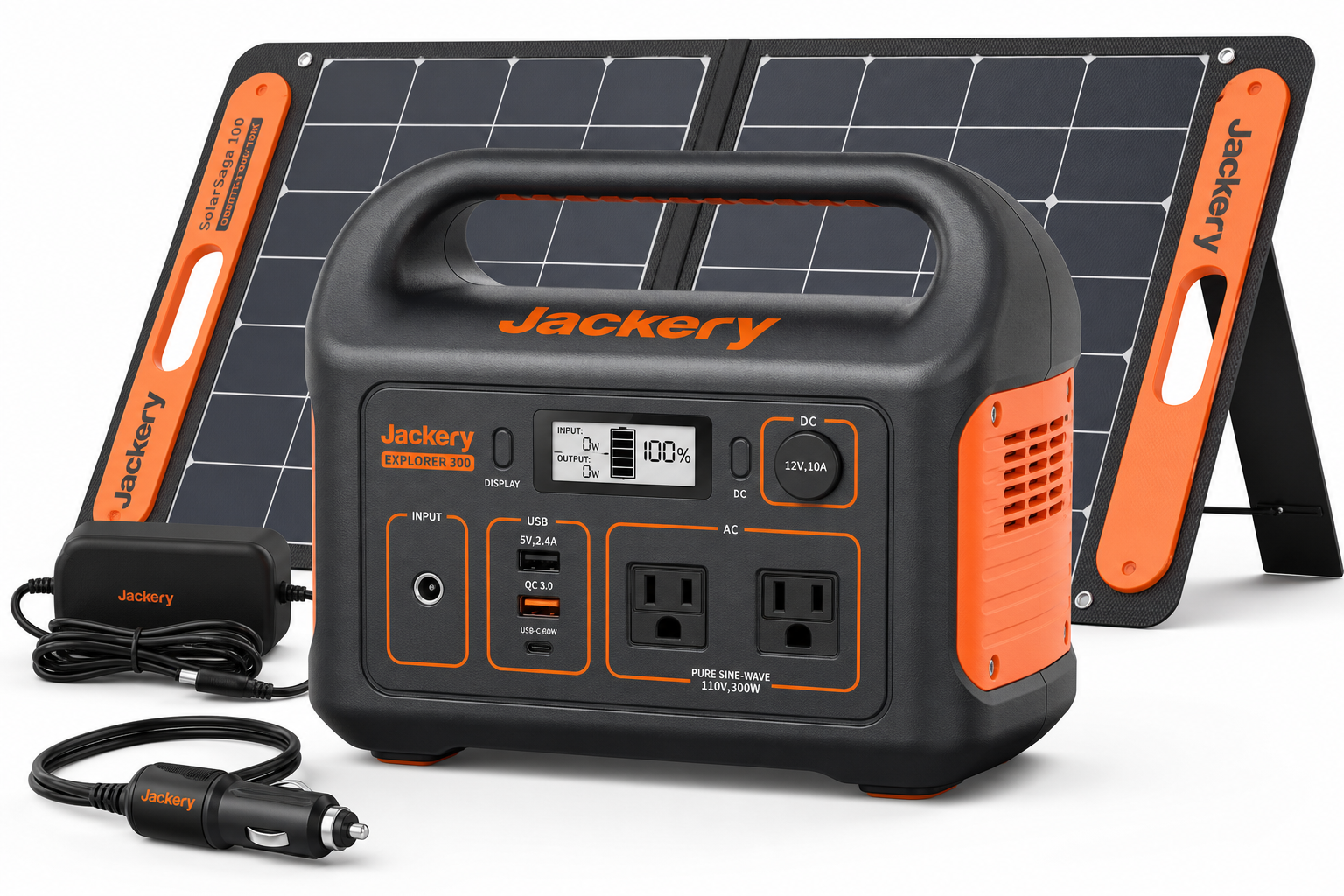
The Jackery Explorer 300 Portable Power Station (≈292–293Wh) is a small, grab-and-go power station targeted at campers, travelers, and homeowners who want a lightweight backup for essential electronics. It combines a roughly 300Wh battery, a 300W pure sine wave inverter (500–600W surge depending on revision), and a mix of AC, DC, and USB outputs into a compact housing that weighs around 7–8 lb.(jackery.com)
Core capabilities include:
- Battery capacity: about 292–293Wh (20.4Ah at 14.4V).
- Inverter: 300W continuous pure sine wave, 500W peak, with two 110V AC outlets.
- DC/USB outputs: 12V 10A car socket, USB-A (one standard, one Quick Charge 3.0), and a USB-C PD port up to 60W (input/output).(manuals.plus)
- Charging: up to ~90W via 8mm DC input from AC adapter or solar (Jackery recommends a 100W panel), plus USB-C PD charging on supported versions.(manuals.plus)
On Amazon at around $259.00, it sits in the budget-to-midrange segment of compact power stations, priced competitively against similarly sized units from brands like EcoFlow and Anker.
Target Users
The Jackery Explorer 300 is best suited for:
- Weekend campers and car campers who need to run lights, charge phones, tablets, cameras, drones, and maybe a small fan or portable fridge for a night.
- Road trippers and van dwellers (light-duty) who want a simple box to charge laptops and devices or power a cooler intermittently.
- Remote workers and students who need to keep a laptop, phone, and router/modem running through short power outages.
- CPAP or medical-device users (short runtime) who need a compact backup for a single night or emergency use (always check your device’s power draw and consult a medical professional for critical use).
- Homeowners preparing for brief blackouts who mainly care about keeping communication devices, Wi‑Fi, and a few small appliances going for several hours.
It is not aimed at users who need to run high-draw appliances (space heaters, full-size refrigerators, power tools) for extended periods or those who want whole‑home backup.
Main Benefits
1. Portable, Backpack-Friendly Form Factor
At roughly 9.1 x 5.2 x 7.8 inches and around 7.1 lb, the Explorer 300 is small enough to carry in one hand and light enough to toss into a car, RV, or large backpack.(manuals.plus) This portability is one of its main advantages over larger, heavier power stations.
2. Well-Balanced 292–293Wh Capacity
Around 300Wh is a practical middle ground for many users:
- Several phone charges (well over a dozen, depending on model).
- 2–4 laptop charges for typical ultrabooks.
- Several hours of runtime for a portable fridge, router, or fan, depending on load.
Jackery’s own runtime estimate uses: Working time ≈ 293Wh × 0.85 ÷ device wattage.(m.media-amazon.com) For example:
- 30W Wi‑Fi router: ≈ 8 hours.
- 60W laptop: ≈ 4 hours.
- 10W LED lighting: well over 20 hours.
3. Pure Sine Wave AC for Sensitive Electronics
The 300W pure sine wave inverter provides clean power for laptops, audio equipment, cameras, and other sensitive electronics. This is safer and more compatible than modified sine wave inverters found in some cheaper units.(manuals.plus)
4. Flexible Port Selection
The Explorer 300 can power multiple devices simultaneously via:
- 2× AC outlets for small appliances and chargers.
- 1× 12V car port for coolers, tire inflators, etc.
- 2× USB-A ports, including one Quick Charge 3.0.
- 1× USB-C PD (up to 60W) for modern laptops, tablets, and phones, which can also serve as an input on supported versions.
This mix allows you to charge or power up to six devices at the same time, a strong point for camping groups or families.(manuals.plus)
5. Multiple Recharge Options, Including Solar
You can recharge the Jackery Explorer 300 via:
- AC wall adapter (up to about 90W, typically 4–5 hours from empty under ideal conditions).
- 12V car socket (slower, but convenient on road trips).
- Solar panels (up to ~90–100W via the 8mm DC input; Jackery recommends a 100W panel such as the SolarSaga 100).(manuals.plus)
This combination makes it viable for off‑grid trips, as you can top it up daily with a panel under good sun.
6. Simple Operation and Clear Display
The front LCD shows battery percentage, input and output wattage, and charging status. The controls are straightforward: dedicated power buttons for AC, DC, and USB sections with clear icons, which is friendly even for non‑technical users.
Key Considerations
1. Battery Chemistry and Cycle Life
Depending on the specific revision, the Explorer 300 may use lithium-ion (NMC) or LiFePO₄ cells. Earlier versions were NMC, while newer “updated” Explorer 300 and related 300-series models are moving to LiFePO₄ for longer cycle life (often rated in the thousands of cycles versus hundreds).(faq.jackery.com)
For buyers today, this means:
- Check the product details and user Q&A on the Amazon listing to confirm whether the unit is the updated LiFePO₄ model or the legacy NMC version.
- LiFePO₄ will generally offer better long‑term durability and slightly better safety margins, at the expense of slightly higher weight and size.
2. Limited Output Power (300W)
The 300W inverter rating significantly shapes what this unit can and cannot do:
- It’s fine for laptops, small fans, LED TVs, routers, small portable fridges, cameras, lights.
- It’s not suitable for microwaves, hair dryers, kettles, toasters, or many power tools, which often exceed 800–1500W.
Short peaks up to 500W can help with startup surges on small compressors or motors, but sustained high‑wattage loads will cause overload protection to trip.(manuals.plus)
3. Capacity Limits for Longer Outages
While ~300Wh is excellent for short trips and brief blackouts, it can feel limiting for multi‑day outages or energy‑hungry gear (such as a full‑time compressor fridge or CPAP with heated humidifier). If you routinely need power for:
- Multi‑day boondocking, or
- High‑duty medical devices overnight, or
- Multiple AC appliances at once,
then a 500–1,000Wh class station may be more appropriate.
4. Charging Speed Expectations
In practice, some users have reported slightly lower-than-advertised AC charge rates (e.g., ~75W vs the stated 90W maximum) depending on wall adapters and conditions.(reddit.com) This doesn’t prevent the unit from working well, but means a full recharge might take longer than marketing numbers suggest.
5. No True UPS Mode
The Explorer 300 does not function as a low‑transfer‑time uninterruptible power supply (UPS). While you can keep it plugged into the wall and run devices from its AC outputs, there is a brief transfer delay when grid power fails, which may cause sensitive equipment (like some desktops) to reboot.(reddit.com)
Pros
- Highly portable: compact dimensions and relatively low weight make it easy to carry and store.
- Versatile port selection: AC, DC, USB-A, and USB-C PD cover most devices you’d realistically bring camping.
- Clean 300W pure sine wave AC suitable for sensitive electronics.
- Reasonable capacity (≈292–293Wh) for weekend trips and short outages.
- Solar-ready via 8mm DC port, compatible with 100W panels for off‑grid recharging.
- Simple interface and clear display, beginner-friendly.
- Wide ecosystem and brand recognition from Jackery, plus good documentation and accessories support.(jackery.com)
Cons
- Limited 300W inverter restricts use to small appliances; many household devices will overload it.
- Modest capacity may not cover multi‑day outages or heavy-duty camping setups without frequent recharging.
- Battery chemistry varies by revision; some units in circulation still use older NMC cells with lower cycle life compared to LiFePO₄-focused competitors.
- AC charging speed can be lower in real-world use than the theoretical 90W max, stretching full recharge times.(reddit.com)
- Lacks true UPS functionality, so it’s not a direct replacement for a dedicated UPS for critical equipment.(reddit.com)
Alternatives
If you’re considering the Jackery Explorer 300, these types of alternatives may also be worth a look:
-
Higher-Capacity Jackery Models (e.g., Explorer 500, 1000 series)
- Better for users who frequently experience long outages or want to run more demanding appliances like larger fridges or multiple devices simultaneously.
- Heavier and more expensive than the Explorer 300, but offer substantially more runtime and higher inverter power.(jackery.com)
-
EcoFlow River / River 2 Series
- Competing small power stations with fast AC charging, often reaching 0–100% in about an hour on some models.
- Some offer higher continuous inverter outputs at similar capacities, but fan noise and app complexity may be higher.
-
Anker portable power stations (e.g., SOLIX C-series)
- Known for LiFePO₄ batteries and long cycle life, plus strong USB-C output options.
- Often priced similarly or slightly higher than the Explorer 300 depending on model and sales.
-
Jackery Explorer 300 V2 / 300 Plus (LiFePO₄-focused variants)
- Jackery’s own newer 300-class models with confirmed LiFePO₄ cells and extended cycle life, plus updated I/O and efficiency improvements.(faq.jackery.com)
- If you like Jackery’s ecosystem and form factor but prioritize longevity and modern features, these are worth comparing directly against the original Explorer 300.
Conclusion
The Jackery Explorer 300 Portable Power Station (≈292–293Wh) is a well-rounded, compact solution for users who need reliable, quiet power for light-duty applications: camping weekends, road trips, and short home outages. Its strengths are portability, a practical mix of ports, pure sine wave AC, and simple operation.
However, its 300W inverter and mid‑size capacity naturally limit what it can power and for how long. It is best for electronics, communications gear, small fans, and compact fridges, not for whole‑home backup or high‑wattage appliances. Prospective buyers should also pay attention to which battery chemistry their specific unit uses, as newer LiFePO₄-based versions offer better long‑term durability.
If your needs align with light to moderate loads and you value a small, easy‑to‑handle unit from an established brand, the Explorer 300 offers a solid balance of capability and convenience at around $259.00 on its Amazon listing. For heavier power requirements or long-term, daily cycling, stepping up to a larger, LiFePO₄-focused model—either from Jackery’s newer Explorer 300 variants or alternative brands—will be the more future-proof choice.