
Jackery Explorer 300 Portable Power Station Review: Compact LiFePO4 Power for Camping and Backup
This review covers the **Jackery Explorer 300 Portable Power Station, 292Wh Backup LiFePO4 Battery, Solar Generator for Outdoors, Camping, Travel, Hunting, Blackout (Solar Panel Optional)**. We examine its compact 292Wh LiFePO4 battery, 300W pure sine wave inverter, mixed AC/DC/USB outputs (including high‑power USB‑C), and solar‑ready design. Key points include its role as a lightweight, grab‑and‑go unit for short trips and emergency backup, the advantages of LiFePO4 chemistry for long cycle life and safety, its strengths in versatility and ease of use, and limitations such as modest capacity and power output compared with larger stations. The article concludes with guidance on who the Explorer 300 best suits and when buyers may want to step up to a higher‑capacity model.
Overview
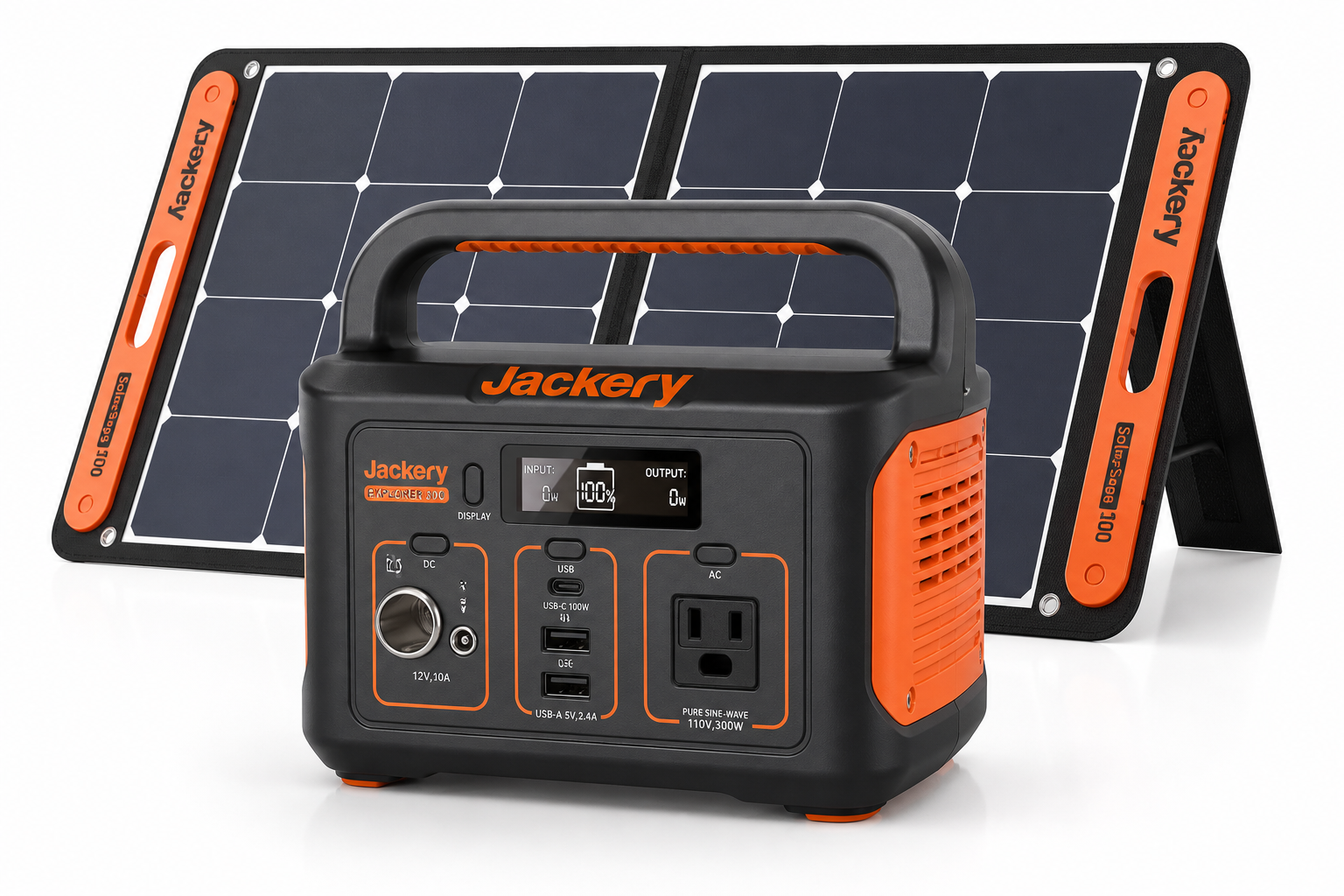
The Jackery Explorer 300 Portable Power Station,292Wh | Backup LiFePO4 Battery, Solar Generator for Outdoors, Camping, Travel, Hunting, Blackout (Solar Panel Optional) is a compact, mid‑entry portable power station designed for users who need reliable power on the go without carrying a heavy, high‑capacity unit. With a roughly 292Wh LiFePO4 battery, a 300W (600W surge) pure sine wave inverter, and a mix of AC, DC, and USB outputs, it targets campers, RV travelers, hunters, and homeowners looking for a small backup solution for short outages and essential electronics.
Unlike larger power stations built for whole‑day appliance loads, the Explorer 300 focuses on portability and convenience. It aims to power phones, cameras, laptops, networking gear, and small camping accessories while remaining easy to store, carry, and recharge from the wall, car, or compatible solar panels.
Key Highlights
- 292Wh LiFePO4 battery for improved cycle life, safety, and stability
- 300W pure sine wave AC inverter with up to 600W surge for short bursts
- Multiple outputs including AC, DC car socket, USB‑A, and high‑power USB‑C
- Solar‑ready design (solar panel optional) for off‑grid recharging
- Compact and lightweight form factor suitable for travel and car camping
- Quiet operation with no exhaust or fuel, suitable for indoor and tent use
These highlights position the Jackery Explorer 300 as a versatile, grab‑and‑go power hub rather than a full‑scale home backup system.
Core Features
Battery and Chemistry
- Capacity: Approximately 292Wh (often specified around 15.2Ah at 19.2V DC)
- Chemistry: LiFePO4 (lithium iron phosphate)
- Benefits of LiFePO4:
- Higher cycle life compared with typical NCM/NCA lithium‑ion cells
- Better thermal stability and safety profile
- More consistent performance across a wider temperature range
This chemistry makes the Explorer 300 especially attractive for users who expect to recharge frequently—such as regular campers or those integrating it into a light off‑grid or UPS‑style setup.
Inverter and Output Power
- AC Output: 120V, 300W continuous with up to 600W surge
- Waveform: Pure sine wave, better for sensitive electronics like laptops, monitors, and medical devices that specify pure sine power
A 300W ceiling comfortably supports low‑ to moderate‑draw devices—LED lighting, routers, modems, phones, tablets, and many laptops—while being unsuitable for high‑draw appliances like hair dryers, toasters, or standard coffee makers.
Ports and Connectivity
Typical output mix includes:
- AC outlets: For small appliances and laptop chargers
- USB‑C port: High‑power USB‑C PD (commonly up to 100W) for modern laptops, tablets, and fast‑charging phones
- USB‑A ports: For phones, small gadgets, and legacy devices
- 12V car socket: For camping fridges, air pumps, or automotive accessories
This port selection allows the Explorer 300 to simultaneously power several devices—often up to six at once—making it a convenient central power hub at a campsite or in a small RV.
Recharging Options
The Jackery Explorer 300 supports three main charging methods:
- Wall (AC) charging using the included adapter
- Car charging via 12V outlet while driving
- Solar charging from compatible solar panels (solar panel optional)
Solar input commonly accepts a range around 12.6–22V DC via a DC barrel/Jackery interface, making the unit compatible with Jackery’s own SolarSaga panels and many third‑party options (with correct voltage and connector). This flexibility lets you build a simple solar generator for extended off‑grid use.
Usage Experience
Setup and Everyday Use
Out of the box, setup is straightforward:
- Charge from a wall outlet or vehicle
- Press the main power and individual output buttons as needed
- Plug devices into AC, DC, or USB ports
A clear front display typically shows remaining battery percentage, input power, and output power so you can monitor usage and manage expectations.
Portability and Handling
The Explorer 300 is designed for grab‑and‑go use:
- Compact dimensions that tuck easily into a car trunk or RV cabinet
- Integrated carry handle for one‑handed transport
- Lighter than higher‑capacity stations, making it reasonable to carry between a vehicle, campsite, and home
For short camping trips or weekend overnights, its form factor is a major advantage over larger models that can be cumbersome to move and store.
Real‑World Power Scenarios
While runtimes depend heavily on device wattage, the Explorer 300’s capacity aligns well with scenarios such as:
- Phones and tablets: Multiple full charges for several devices
- Laptop use: Several hours of work time for a typical 60–80W laptop, especially if you dim the screen and manage power settings
- Networking gear: Keeping a modem and Wi‑Fi router running through a short outage or preserving connectivity in a blackout
- Camping accessories: Running LED lights, a small fan, or a low‑draw portable fridge for defined periods
In practice, this makes the Jackery Explorer 300 a strong fit for users who want to keep communications, lighting, and essential work tools online rather than trying to run full‑size household appliances.
Noise and Heat
Because it is battery‑based, the Explorer 300 operates quietly, with only occasional fan noise when charging at higher rates or running closer to its capacity. This low noise level is well‑suited to tents, small RV interiors, and quiet nighttime environments.
Strengths
-
LiFePO4 Longevity and Safety
The use of LiFePO4 cells provides long cycle life and a robust safety profile, important for users planning multi‑year, frequent use. -
Well‑Balanced Capacity and Weight
Around 292Wh is enough for phones, laptops, and small electronics over a weekend, while keeping the overall weight manageable. -
Versatile Port Selection
Combining AC outlets, USB‑C PD, USB‑A, and a car socket means one unit can handle charging and powering a broad mix of devices without extra adapters. -
Solar‑Ready Flexibility
With appropriate panels, the Explorer 300 can function as a compact solar generator, extending runtime indefinitely in sunny conditions. -
User‑Friendly Design
Intuitive controls, a readable display, and clear labeling make it accessible for non‑technical users. -
Pure Sine Wave Output
Safer and more compatible with sensitive electronics than modified sine wave inverters found in some budget alternatives.
Weaknesses
-
Limited Capacity for High‑Demand Loads
At 292Wh, this unit is not meant for powering large appliances, power tools, or long‑duration fridge use. Heavy users may find the runtime restrictive. -
300W Inverter Ceiling
Devices over 300W continuous simply are not supported, meaning you must carefully check wattage requirements for anything beyond laptops and small gear. -
Dependence on External Solar Panel
While solar‑ready, it does not include a panel by default. To fully leverage off‑grid capability, you must purchase a compatible panel separately. -
No Smart‑App Integration
Unlike some newer, higher‑end stations, the Explorer 300 generally does not include Bluetooth or Wi‑Fi app control, which may matter to users who want remote monitoring. -
Single Small‑Capacity Role
As your needs grow—running a portable fridge all day, supporting multiple laptops, or handling repeated blackouts—the Explorer 300 can start to feel like a supplemental solution rather than a central power source.
Suitable Scenarios
The Jackery Explorer 300 is particularly well‑suited to:
- Weekend camping and road trips where you need to power phones, lights, cameras, and a laptop or two
- Short‑duration blackouts to keep a modem, router, and key devices like phones or a single low‑power laptop running
- Vanlife and car‑based travel as a compact secondary unit for electronics and small accessories
- Outdoor work sessions where you need silent, emission‑free power for laptops, tablets, and camera gear
- Hunting trips and fishing outings where a small, quiet power source is needed for lights, comms, and navigation gear
It is less ideal for:
- Running high‑draw kitchen appliances
- Powering multiple large devices simultaneously for extended periods
- Serving as the primary backup for a whole household during multi‑day outages
Final Evaluation
The Jackery Explorer 300 Portable Power Station,292Wh | Backup LiFePO4 Battery, Solar Generator for Outdoors, Camping, Travel, Hunting, Blackout (Solar Panel Optional) occupies a well‑defined niche: a compact, LiFePO4‑based portable power station tailored for light to moderate loads, frequent transport, and regular cycling.
Its combination of a ~292Wh LiFePO4 battery, 300W pure sine wave inverter, versatile port selection, and solar‑charging capability creates a compelling option for campers, travelers, and homeowners who prioritize portability and reliability over raw capacity. The tradeoffs—limited power for large appliances and the need for separate solar panels—are expected in this class of product and will mainly affect users whose demands exceed what a small station can provide.
For buyers seeking a quiet, easy‑to‑use, and long‑lasting portable power station to keep essential devices running during trips and brief outages, the Jackery Explorer 300 is a strong contender. Users needing to support bigger loads or longer off‑grid stays should see it as a solid starting point and consider stepping up to a higher‑capacity model in the same ecosystem when their requirements grow.