
Garmin eTrex 22x Review: Rugged, Old‑School GPS That Still Delivers Reliable Navigation
This review examines the **Garmin 010-02256-00 eTrex 22x, Rugged Handheld GPS Navigator (Black/Navy)**, a compact, button‑operated hiking GPS designed for reliability in the backcountry. We cover what the eTrex 22x is, why it still matters in the age of smartphones, its main strengths—such as rugged construction, long battery life, GPS+GLONASS support, and preloaded TopoActive maps—as well as its limitations, including a small non‑touch display and basic feature set compared to higher‑end Garmin units. The review also explains who will benefit most from this device (hikers, hunters, cyclists, and geocachers needing dependable offline navigation) and who may be better served by a more advanced or more user‑friendly GPS unit.
What This Product Is
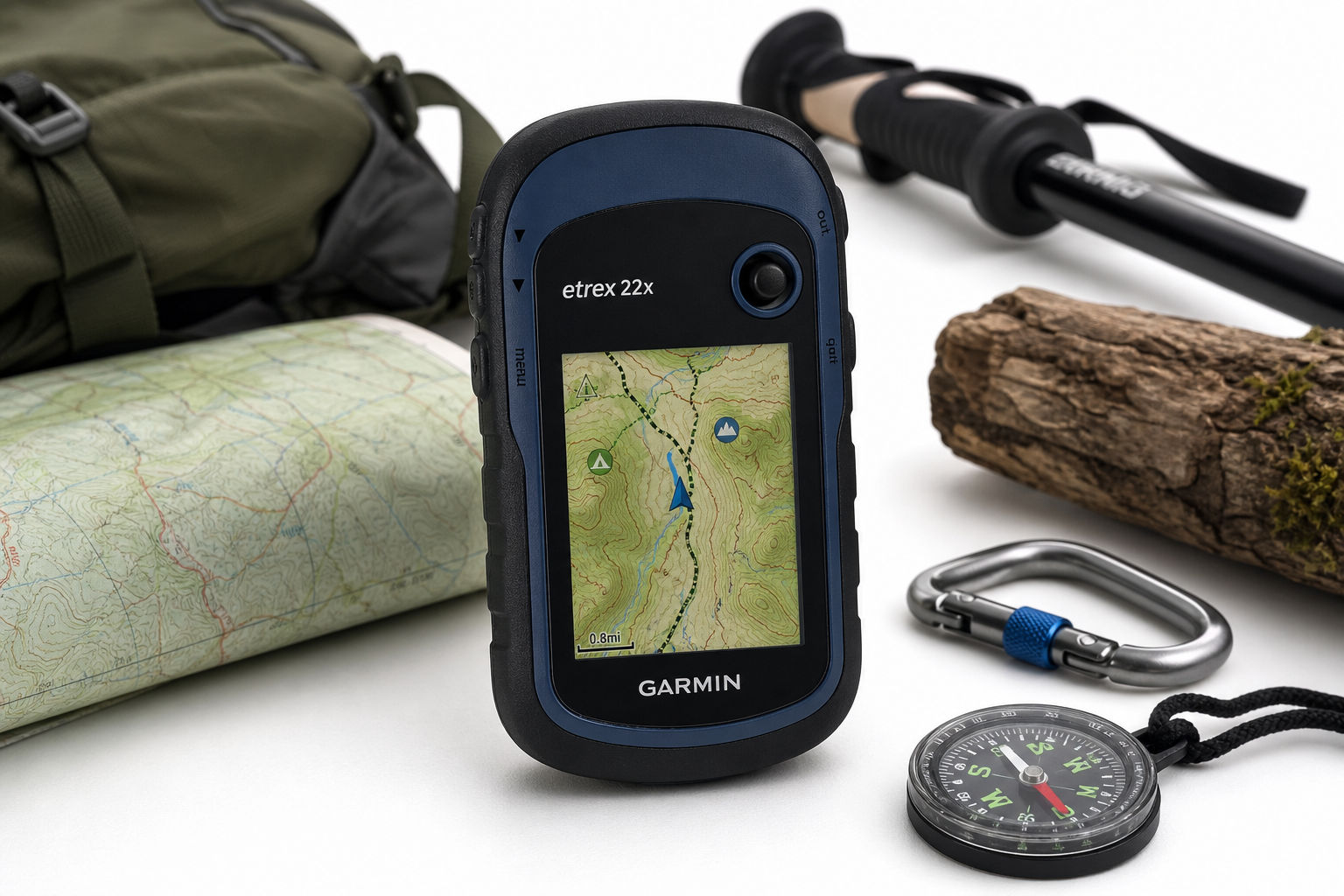
The Garmin 010-02256-00 eTrex 22x, Rugged Handheld GPS Navigator, Black/Navy is a compact, button‑based handheld GPS aimed at hikers, hunters, cyclists, and other outdoor users who need reliable, offline navigation in harsh conditions.
Key characteristics:
- Rugged handheld design with IPX7 water rating (submersion in 1 meter of water for up to 30 minutes) and a rubberized housing designed to withstand bumps and drops.
- 2.2-inch color display (240 × 320 pixels), sunlight‑readable and deliberately small to save power.
- Multi‑GNSS support: uses both GPS and GLONASS satellite systems to improve positioning in challenging terrain like forests, canyons, or steep valleys.
- Preloaded TopoActive maps (region‑dependent) with routable roads and trails suitable for hiking and cycling.
- 8 GB internal storage plus microSD slot for loading additional maps (topographic, marine, or road maps).
- Up to 25 hours of battery life in GPS mode with two AA batteries (alkaline, NiMH, or lithium), making it suitable for multi‑day trips with spares.
- Familiar eTrex interface with physical buttons, menus for Map, Where To?, Compass, Trip Computer, Mark Waypoint, and Setup.
In short, the eTrex 22x is a modern refresh of Garmin’s classic entry‑level outdoor GPS line: small, tough, affordable in its category, and focused on core navigation rather than smart features.
Why It Matters
Smartphones with offline maps have reduced demand for dedicated GPS units, but devices like the eTrex 22x still answer several important needs:
-
Reliability when your phone fails
In remote or cold environments, smartphones can run out of battery quickly, overheat, suffer from weak reception, or become unusable when wet. The eTrex 22x is built to keep working in those exact conditions, with AA batteries you can swap in seconds. -
True outdoor durability
The IPX7 water rating and rugged chassis make the device more tolerant of rain, river crossings, mud, and accidental drops than most phones or watches. -
Dedicated navigation focus
The interface is optimized for navigation tasks—marking waypoints, following tracks, checking distance to a destination—without the distractions of notifications, calls, or apps. -
Long, predictable battery life
Up to 25 hours from two AA batteries is practical for multi‑day hikes and backcountry trips. You can carry lightweight spare batteries instead of power banks. -
Map flexibility and expandability
With preloaded TopoActive maps and microSD expansion, you can tailor the device with topographic, marine, or road maps for different regions or activities.
For users who regularly venture beyond reliable cell coverage, the eTrex 22x remains a relevant tool that complements, rather than replaces, a smartphone.
Key Advantages
1. Rugged, Compact Form Factor
The eTrex 22x maintains the classic palm‑sized eTrex profile. At roughly 5 oz (with batteries) and small enough to fit easily in a hand or chest pocket, it’s unobtrusive on a pack strap or lanyard. The physical buttons can be operated with gloves, which is crucial in cold or wet weather.
2. Excellent Battery Life and AA Power
Running on two AA batteries with a rated up‑to‑25‑hour battery life in GPS mode, the device is optimized for extended trips. AA cells are universally available and easy to pack in bulk. This is a major advantage over rechargeable‑only units for thru‑hikers, hunters, and expedition users who can’t recharge often.
3. GPS + GLONASS for Better Reception
By using both GPS and GLONASS satellite networks, the eTrex 22x generally maintains lock more quickly and more reliably in areas where satellite visibility is partially blocked—dense forest, steep canyons, or urban canyons. This translates into more consistent tracking and fewer position dropouts compared with older GPS‑only receivers.
4. Preloaded Routable TopoActive Maps
The inclusion of TopoActive maps means the device is ready to navigate right out of the box. These maps typically include:
- Routable roads and trails, enabling turn‑by‑turn style guidance on many paths and minor roads.
- Topographic detail, which helps with route planning and terrain awareness.
- Points of interest (POIs) like trailheads, campsites, and other landmarks in many regions.
You can also add more maps via the internal memory and microSD slot, tailoring the device to specific countries, off‑road areas, or boat use.
5. Simple, Proven Interface
The eTrex interface is mature and intentionally minimalist:
- The Map screen shows your position, track, and nearby features.
- Where To? allows you to navigate to waypoints, POIs, coordinates, or saved routes.
- The Compass page provides a straightforward bearing pointer.
- Trip Computer displays distance traveled, speed, elevation gain, and other metrics.
While it looks old‑school compared with touchscreens, this design is predictable, consistent across generations, and easy to learn for users willing to spend a bit of time with it.
6. Versatile Mounting Options
With available mounts, the eTrex 22x can be used:
- On handlebars for mountain biking or bikepacking.
- On ATVs, snowmobiles, and motorcycles.
- In vehicles using compatible road maps for turn‑by‑turn directions.
This flexibility lets one device cover multiple outdoor roles.
Key Limitations
1. Small, Non‑Touch Display
The 2.2‑inch screen is intentionally compact, but it feels cramped once you’re used to large phone or modern GPS screens. Map panning and zooming with buttons is noticeably slower than with a touchscreen, and complex map views can feel busy.
2. Basic Feature Set vs Higher‑End Models
Compared with Garmin’s more advanced handhelds (like the eTrex 32x, GPSMAP or Montana series), the eTrex 22x omits several premium features, such as:
- Built‑in electronic compass and barometric altimeter (it relies on GPS‑based direction and elevation instead).
- Wireless sensors and connectivity (ANT+ in other models, Bluetooth in some higher‑end lines).
- Larger, higher‑resolution displays and more powerful processors.
For serious mountaineering, complex route sets, or heavy data‑field customization, power users may find the 22x restrictive.
3. Learning Curve for New Users
If you’ve never used a Garmin handheld before, the menu system can feel dated and a bit unintuitive at first. Functions like loading maps, managing GPX files, or customizing fields are powerful but not self‑explanatory. Many users end up consulting online guides or forums for best practices.
4. Limited On‑Device Planning Tools
The eTrex 22x is great at following existing routes and tracks and marking waypoints. However:
- Building complex, multi‑segment routes is easier on a computer or smartphone, then transferred to the device.
- On‑device map browsing is functional but not as pleasant as on larger touchscreen units.
5. No Built‑In Emergency Communications
Like most classic GPS receivers, the eTrex 22x does not include satellite messaging, SOS, or cellular connectivity. For backcountry safety, it should be paired with a dedicated satellite communicator or PLB if you travel far from help.
Who It’s For
The Garmin eTrex 22x is well‑suited to:
-
Hikers and backpackers
Those who value long battery life, simple navigation, and tough hardware will appreciate this device, especially on multi‑day trips where power outlets are scarce. -
Hunters and anglers
Marking stands, blinds, wallows, and productive spots, then reliably navigating back before dawn or after dark, is exactly what the eTrex line excels at. -
Bikepackers and mountain bikers
With appropriate mounts and maps, the eTrex 22x can guide you along forest roads, singletrack, and gravel routes while drawing far less power than a smartphone. -
Geocachers and outdoor educators
The straightforward waypoint and track management make it a solid tool for geocaching, land navigation training, or teaching map/GPS basics. -
Users who prefer AA‑powered devices
Anyone who regularly travels in areas without reliable electricity—or who already carries AA‑powered headlamps, radios, or cameras—will like the logistical simplicity.
Who Should Skip It
You may want to look elsewhere if you are:
-
A casual user who rarely leaves cell coverage
If your adventures are mostly on well‑marked local trails with good phone service, a smartphone with a quality offline mapping app may be sufficient. -
A user who prioritizes a big, modern touchscreen
If you find small, button‑driven interfaces frustrating, a larger touchscreen handheld or a smartphone‑based solution will likely make you happier. -
A data‑driven athlete or mountaineer
Users who want advanced training metrics, sensor pairing, or detailed elevation and weather data might be better served by higher‑end Garmin handhelds or multisport watches. -
Someone needing all‑in‑one navigation and emergency messaging
If you want built‑in SOS, two‑way satellite messaging, or live tracking without extra gear, you’ll need a different device class (for example, a handheld with inReach technology or a dedicated communicator to pair with your GPS). -
Users who demand the latest smart features
There is no app ecosystem, no music, no notifications, and no touchscreen gestures. The eTrex 22x is intentionally utilitarian; if you want a smartwatch‑like experience, this is not it.
Final Recommendation
The Garmin 010-02256-00 eTrex 22x, Rugged Handheld GPS Navigator, Black/Navy is a deliberately simple, robust, and dependable navigation tool. It doesn’t try to compete with smartphones or premium handhelds on interface flash or feature density. Instead, it delivers:
- A tough, water‑resistant build.
- Long, predictable battery life with easy‑to‑source AA batteries.
- Reliable GPS+GLONASS tracking.
- Useful preloaded TopoActive maps and expandable storage.
If you value reliability, battery life, and durability over cutting‑edge screens and connectivity—and you’re willing to accept a smaller display and more traditional interface—the eTrex 22x remains a highly practical choice for backcountry navigation.
For users who want more advanced sensors, larger displays, or integrated communication features, it serves as a baseline: a reminder that sometimes a simple, rugged GPS that just works can be the most valuable device in your pack.