
FosPower NOAA Emergency Weather Radio A1 Review: Portable Backup Power, Lighting, and Weather Alerts
The FosPower NOAA Emergency Weather Radio A1 combines NOAA weather alerts, AM/FM radio reception, a 7400mWh power bank, multiple charging methods, an SOS alarm, and two LED lighting sources in a compact emergency-preparedness device. This review examines its feature set, power options, portability, usability, and limitations, including its modest flashlight output, IPX3 water resistance, and the need to supply AAA batteries separately.

4.2(Based on 72 reviews)
FosPower NOAA Emergency Weather Radio A1 7400mWh Portable Power Bank, AM/FM, USB/Solar/Hand Crank Charging, Battery Operated, SOS Alarm & Flashlight for Indoor/Outdoor Emergency - Black
SHOP NOW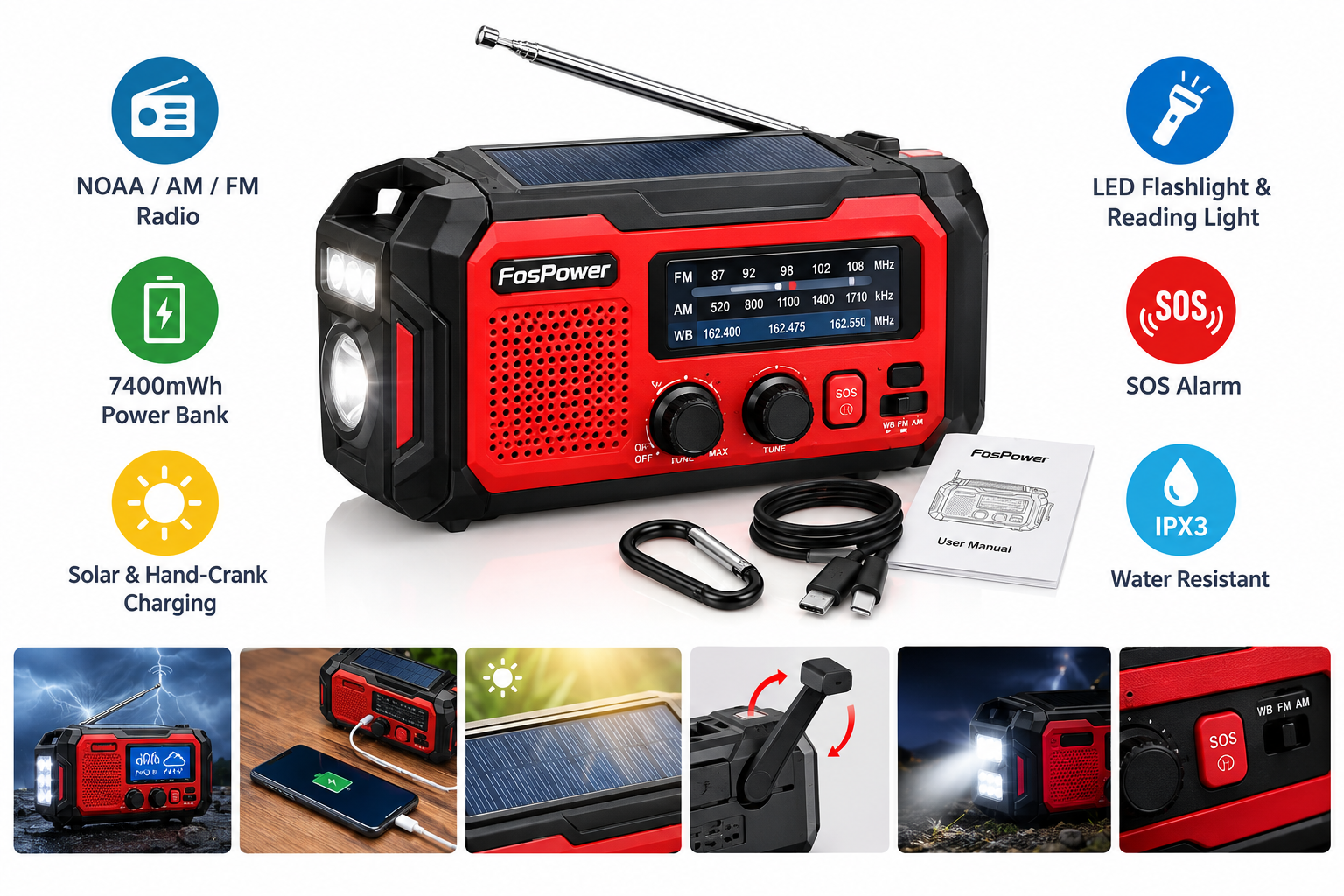
Product Context
The FosPower NOAA Emergency Weather Radio A1 is designed as a multipurpose backup device for power outages, severe weather, camping, travel, and household emergency kits. Rather than functioning only as a radio, it combines weather-broadcast reception with device charging, lighting, an SOS alarm, and several power sources.
The unit measures approximately 6.2 × 2.9 × 2.1 inches and weighs about 10.9 ounces. Its compact size makes it practical for storage in a drawer, vehicle emergency kit, backpack, or camping supply box.
Feature Breakdown
NOAA and AM/FM Radio Reception
The radio supports NOAA weather broadcasts along with AM and FM stations. NOAA access is particularly useful during severe weather or other situations when internet, television, or cellular service may be unavailable. The listed frequency ranges are 520–1710 kHz for AM, 87–108 MHz for FM, and 162.400–162.550 MHz for weather-band reception.
7400mWh Power Bank
The integrated power bank is listed at 7400mWh, equivalent to a nominal 2000mAh capacity. It is intended to provide emergency power to compatible USB-powered devices such as smartphones, small tablets, or other portable electronics. This capacity is better viewed as a backup charging resource rather than a replacement for a full-size power bank.
Four Power Sources
The A1 supports four power methods: its rechargeable lithium-ion battery, AAA batteries, a solar panel, and a hand-crank generator. The rechargeable battery provides stored power, while the solar panel and crank offer regenerative options when conventional charging is unavailable.
AAA batteries are not included, so they must be purchased separately if users want that additional backup option. Solar and hand-crank charging are useful for extending operating time, although both methods are generally slower and more labor-intensive than USB charging.
Dual LED Lighting
The radio includes a four-LED reading light and a 1-watt LED flashlight. The flashlight is listed at 20 lumens and includes a zoom function, making it suitable for basic navigation, locating items, or illuminating a nearby area. The reading light is more appropriate for a small table, tent, or emergency workspace.
SOS Alarm and Accessories
An SOS alarm provides an audible signaling option during an emergency. The package includes a USB-C-to-USB-A cable, carabiner, and owner's manual. The carabiner can make it easier to attach the radio to a backpack or other gear, although users should avoid assuming that the carabiner makes the unit suitable for climbing or load-bearing applications.
Performance Insights
The A1's main advantage is functional redundancy. If the internal battery is depleted, the user can switch to AAA batteries, expose the solar panel to sunlight, or turn the hand crank. That flexibility is valuable in emergencies because it reduces dependence on a single charging method.
The NOAA weather-band function also adds practical value over a basic AM/FM radio. Access to weather broadcasts can help users monitor storms, warnings, and changing conditions when other communication channels are unreliable.
The power bank should be considered an emergency top-up source. A 2000mAh rating can provide useful additional battery life for a phone, but actual results depend on charging losses, the connected device, and how much stored energy remains for radio and lighting functions.
Lighting performance appears oriented toward close-range utility rather than wide-area illumination. The reading light can help with tasks, while the 20-lumen flashlight is best suited to short-distance visibility. Users who need a powerful beam for outdoor search or extended nighttime travel may need a separate flashlight.
Usability
The compact body and included carabiner support portable use, while the combination of radio, flashlight, alarm, and charging functions reduces the number of separate devices needed in an emergency kit. The controls and features are designed for straightforward access, but users should familiarize themselves with tuning, charging, and alarm operation before an emergency occurs.
For best preparedness, the radio should be fully charged periodically, tested in the intended storage location, and checked for reliable NOAA reception. It is also sensible to keep spare AAA batteries nearby and store the included cable with the unit.
The product is rated IPX3 for water resistance. This indicates limited protection from spraying water, but it should not be treated as waterproof or immersed. For outdoor use, it should be protected from heavy rain and prolonged moisture exposure.
Trade-offs
The FosPower A1 offers broad functionality, but its all-in-one design comes with several compromises:
- The power bank has limited capacity compared with dedicated high-capacity battery packs.
- Solar and hand-crank charging are emergency fallback methods, not fast everyday charging solutions.
- The 20-lumen flashlight is designed for basic illumination rather than long-range lighting.
- AAA batteries are not included.
- IPX3 protection provides only limited resistance to sprayed water.
- The device may require periodic maintenance, including battery checks and occasional radio testing.
- Combining multiple functions in one unit means it may not match the specialized performance of a dedicated weather radio, power bank, or flashlight.
The product includes a limited lifetime warranty according to the listed product information, but users should review the manufacturer's current warranty terms for coverage and registration requirements.
Conclusion
The FosPower NOAA Emergency Weather Radio A1 is a practical emergency-preparedness tool for users who want weather alerts, AM/FM radio reception, backup device charging, lighting, and an SOS alarm in one portable unit. Its multiple power sources are the strongest feature, particularly for outages, camping, and situations where conventional charging is unavailable.
Its limitations are important to understand: the power bank is modest, the flashlight output is basic, AAA batteries are sold separately, and the IPX3 rating does not make the radio waterproof. Within those boundaries, the A1 is a versatile addition to a household, vehicle, or outdoor emergency kit—especially when maintained, tested, and stored with spare batteries and compatible charging accessories.