
EF ECOFLOW RIVER 3 Portable Power Station Review: Compact Backup Power with Fast Charging and LiFePO₄ Battery
The EF ECOFLOW RIVER 3 is a compact 245Wh LiFePO₄ portable power station with a 300W AC inverter (up to 600W with X-Boost), fast 1‑hour charging, and flexible input options including AC, car, and solar. This review looks at what the RIVER 3 is, why it matters for portable and emergency power, its key strengths and limitations, and who will get the most value from this small but capable unit.
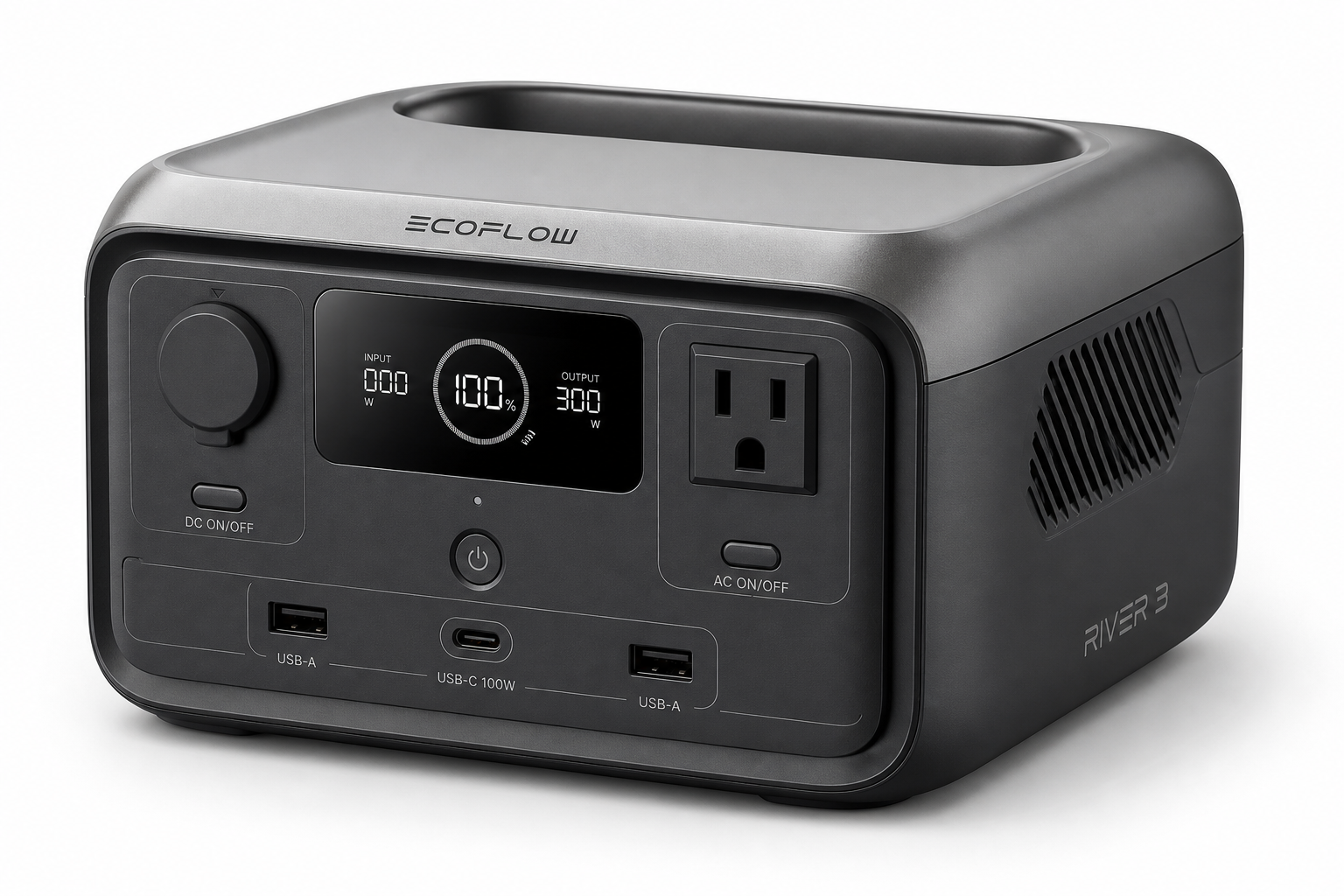
What This Product Is
The EF ECOFLOW Portable Power Station RIVER 3 is a small, lightweight power station built around a 245Wh LiFePO₄ battery. It’s designed to provide reliable portable power for camping, RV trips, light off‑grid use, and modest home backup.
Core capabilities include:
-
Battery & Output
- ~245Wh LiFePO₄ battery rated for around 3000+ cycles to 80% capacity. (manuals.plus)
- 300W pure sine wave AC output (continuous) suitable for laptops, small appliances, and electronics. (us.ecoflow.com)
- X‑Boost up to 600W, allowing it to power some higher‑draw devices (within limits). (us.ecoflow.com)
- Total combined output up to 550W across all ports. (images.thdstatic.com)
-
Ports & Connectivity
- 1× AC outlet (region‑specific voltage, pure sine). (santansolar.com)
- DC car‑style output (~12.6V, up to 10A) for 12V devices. (santansolar.com)
- USB‑A ports up to 12W each and a high‑power USB‑C (up to 100W) for fast laptop and device charging. (manuals.plus)
- App control and monitoring via the EcoFlow app over Wi‑Fi/Bluetooth (varies by region/version).
-
Input & Charging
- AC fast charging: can recharge from empty to about 80% in roughly 1 hour under ideal conditions. (us.ecoflow.com)
- Solar input up to 110W (11–30V, up to 8A) for use with portable panels. (manuals.plus)
- 12V/24V car charging support for on‑the‑road top‑ups. (manuals.plus)
-
Form Factor & Design
- Approx. 245Wh in a compact, lightweight shell—significantly smaller than many competing ~250–300Wh units. (techradar.com)
- Integrated carry handle and front display with battery percentage, estimated runtime, and port status.
On Amazon (product page: https://www.amazon.com/dp/B0DB1S36YP), the RIVER 3 is typically positioned as an affordable, entry‑level portable power station. If you see it listed at $202.37, that puts it in line with other compact LiFePO₄ units in the ~200–300Wh class.
Why It Matters
For many people, a massive whole‑home battery is overkill. What’s often more practical is a small, fast‑charging, long‑life unit that keeps phones, Wi‑Fi, medical devices, and a few essentials running during outages or while travelling.
The EF ECOFLOW RIVER 3 matters because it combines:
- LiFePO₄ longevity: safer chemistry with long cycle life, making it a better long‑term investment than older lithium‑ion NMC packs. (manuals.plus)
- True portability: 245Wh and 300W output in a compact, easy‑carry body.
- Rapid AC recharging: far quicker top‑ups than many similarly sized competitors. (techradar.com)
- UPS‑style functionality (model‑dependent): certain RIVER 3 variants support a sub‑20ms transfer time, making them suitable as basic UPS for PCs, networking gear, or CPAP devices. (us.ecoflow.com)
If you need a grab‑and‑go backup solution that can live near a desk, in an RV, or in a closet for emergencies, the RIVER 3 hits a sweet spot of capacity, speed, and durability.
Key Advantages
1. Long‑Life LiFePO₄ Battery
The RIVER 3 uses LiFePO₄ cells, rated for around 3000 cycles before capacity drops to about 80%. (manuals.plus) This is a major advantage over older lithium‑ion units that may only reach 500–800 cycles. For anyone planning frequent use—RV travellers, off‑grid workers, or those cycling daily for peak‑shaving—this significantly extends the usable lifespan.
2. Fast 1‑Hour AC Charging
EcoFlow’s high‑speed AC charging means the RIVER 3 can recover from empty to a substantial charge in about an hour, which is very fast for a 245Wh pack. (us.ecoflow.com) Practically, this allows you to:
- Top up quickly between brownouts.
- Charge during short generator runs to save fuel.
- Recharge in a café, office, or RV park without needing all day.
3. Flexible Power Outputs, Including 100W USB‑C
The mix of ports covers most small‑device scenarios:
- 300W AC outlet for small appliances, projectors, or a laptop + monitor (within the power envelope). (santansolar.com)
- High‑power 100W USB‑C for modern laptops, tablets, and fast‑charging phones—often removing the need for the AC brick. (manuals.plus)
- Regulated 12V DC output for CPAP machines (with appropriate cable), routers, and other 12V gear. (santansolar.com)
For a compact station, this breadth of outputs gives it excellent versatility as a travel companion and desk‑side backup.
4. X‑Boost Up to 600W for Short‑Term High Loads
EcoFlow’s X‑Boost mode lets the RIVER 3 run certain devices that technically exceed its 300W inverter rating, up to about 600W, by carefully managing voltage and current. (us.ecoflow.com) While it’s not a substitute for a bigger inverter, it can handle:
- Small kettles or cooking devices with reduced power.
- Power tools that only briefly spike above 300W.
- Appliances like compact coffee makers (for short runtimes, depending on their draw).
Used sensibly, this widens what you can plug in without stepping up to a much larger and heavier unit.
5. UPS‑Style Backup (Model‑Dependent)
Some RIVER 3 variants offer <20ms transfer time from grid to battery, effectively functioning as a basic UPS for desktops, NAS units, and modems/routers. (us.ecoflow.com) That’s not as fast as enterprise‑grade UPS systems but is generally quick enough to avoid reboots on many PCs and networking devices.
This is particularly useful if you:
- Work from home and want protection against brief power glitches.
- Rely on a CPAP or medical device and need seamless switchover (confirm compatibility and safety with your device manufacturer).
- Want your home internet to keep running during short outages.
6. Quiet Operation and Compact Footprint
With EcoFlow’s fan and power management, the RIVER 3 generally stays library‑quiet under light loads, with noise ramping up mainly during heavy discharge or high‑speed charging. (ecoflow.com) Its small footprint also makes it easy to tuck under a desk, in an RV cabinet, or beside a nightstand.
Key Limitations
1. Modest 245Wh Capacity
At 245Wh, this is firmly in the small portable category. That’s ideal for light duty, but it imposes hard limits, for example:
- A typical laptop (40–60W) may run roughly 3–5 hours continuously.
- A Wi‑Fi router and modem (10–15W) could run well over a day. (ecoflow.com)
- A CPAP machine or mini‑fridge can drain the battery in a single night, depending on settings and model.
If you expect to run multiple devices for many hours—especially anything with a compressor or heating element—you’ll quickly find the capacity restrictive. In that case, units like the RIVER 3 Plus/Max or larger Delta series are more appropriate.
2. Single AC Outlet (on Many Variants)
Unlike some competitors with two or more AC sockets, many RIVER 3 configurations provide a single AC outlet. (santansolar.com) You can always add a quality power strip, but you must stay within the 300W (or 600W X‑Boost) limit and be cautious about surge loads.
3. Limited Solar Input
With a 110W max solar input, the RIVER 3 can realistically turn a 100W–110W panel into a full charge in about 3 hours of good sun, longer in real‑world conditions. (manuals.plus) That’s acceptable for a small unit but doesn’t leave much headroom if you’re:
- In low‑sun regions or winter conditions.
- Trying to rely primarily on solar for daily cycling.
For more solar‑centric setups, a unit with higher PV input and larger capacity is a better foundation.
4. Not Meant for High‑Draw Appliances
Even with X‑Boost, sustained high‑power devices (space heaters, full‑size coffee makers, air conditioners, hair dryers) are outside the RIVER 3’s practical scope. You may trip the overload protection or severely limit runtime.
If these appliances are on your must‑run list, you’ll want a larger power station (higher inverter wattage and capacity) rather than pushing this small unit to its limits.
5. Variant Confusion
EcoFlow offers multiple RIVER 3 variants (standard, 10ms UPS version, 230Wh regional versions, Plus/Max). (ecoflow.com) Specs like UPS switchover time and capacity can differ slightly. When buying, carefully check the exact variant code and specifications on the Amazon listing to be sure you’re getting the feature set you expect (e.g., 245Wh capacity and UPS capability).
Who It’s For
The EF ECOFLOW RIVER 3 makes the most sense for users who prioritize portability, fast charging, and long battery life over sheer capacity.
You’re a good fit if:
-
You want an everyday backup for small essentials.
Ideal if you mainly need to keep phones, tablets, laptops, a Wi‑Fi router, and maybe a small fan running during short outages. -
You’re a camper or RVer with modest power needs.
Great for weekend trips, car camping, or vanlife setups where you’re charging devices, running lights, or powering a compact workstation. -
You value LiFePO₄ longevity.
If you’ll be cycling the battery frequently—say, for mobile work or regular off‑grid weekends—the extended cycle life justifies the investment. -
You need a compact UPS‑like solution.
For users who want a basic UPS alternative for a PC, NAS, or networking hardware, the RIVER 3’s rapid switchover (variant‑dependent) and fast recharge are appealing. -
You plan to occasionally top up via solar.
When paired with a 100W–110W folding solar panel, the RIVER 3 can meaningfully extend runtimes in the field, as long as you manage expectations around weather and load.
Who Should Skip It
You may want to look elsewhere if any of the following describes you:
-
You need to power high‑draw appliances.
If your priority is running full‑size refrigerators, heaters, microwaves, or power‑hungry tools, a 300W inverter and 245Wh capacity simply aren’t enough. Consider larger EcoFlow Delta‑class units or similar 1–2kWh systems. -
You require multi‑day, off‑grid autonomy.
For long trips or cabin use where you’re off‑grid for days at a time, the limited capacity and 110W solar input will be restrictive. Scaling up to a higher‑capacity power station or modular system will be more comfortable. -
You want to power multiple AC devices at once.
With a single AC outlet and 300W continuous limit, the RIVER 3 is better suited to powering one primary AC device plus USB/DC loads, not a cluster of big AC appliances. -
Budget units with less emphasis on longevity are acceptable.
If you don’t care about LiFePO₄’s long cycle life and only need occasional backup, you might find cheaper NMC‑based units with similar capacity, accepting shorter lifespan as a trade‑off.
Final Recommendation
The EF ECOFLOW Portable Power Station RIVER 3 is a well‑balanced compact power solution: long‑life LiFePO₄ battery, truly portable size, fast 1‑hour AC charging, and flexible outputs with 300W AC and 600W X‑Boost. Its strengths shine in light‑duty backup, mobile workstations, and short off‑grid trips where you need reliable, rechargeable power for electronics and small devices.
Its main compromises—245Wh capacity, limited solar input, and modest inverter power—mean it’s not a whole‑home or heavy‑appliance solution, and it’s best thought of as a smart, modern replacement for traditional small UPS units and gas‑free generators for light loads.
If your expectations match what this class of device is built for, and the Amazon listing price (for example, $202.37 at https://www.amazon.com/dp/B0DB1S36YP) falls within your budget, the EF ECOFLOW RIVER 3 is an easy product to recommend as a compact, quick‑charging, and durable portable power station for everyday preparedness and travel.