
Anker 521 Portable Power Station Review: Compact LiFePO4 Powerhouse for Camping and Backup
This review examines the **[Anker 521 Portable Power Station](https://www.amazon.com/dp/B09FF46FQ9)**, a 256Wh LiFePO4-based compact power station with a 300W (600W peak) inverter, 6 output ports, optional solar charging, and a 60W USB-C PD port. It focuses on real-world suitability for camping, road trips, and small home backup tasks, covering battery chemistry longevity, port layout, output performance, noise, and usability trade-offs such as limited AC wattage and capacity constraints compared with larger power stations.
Product Context
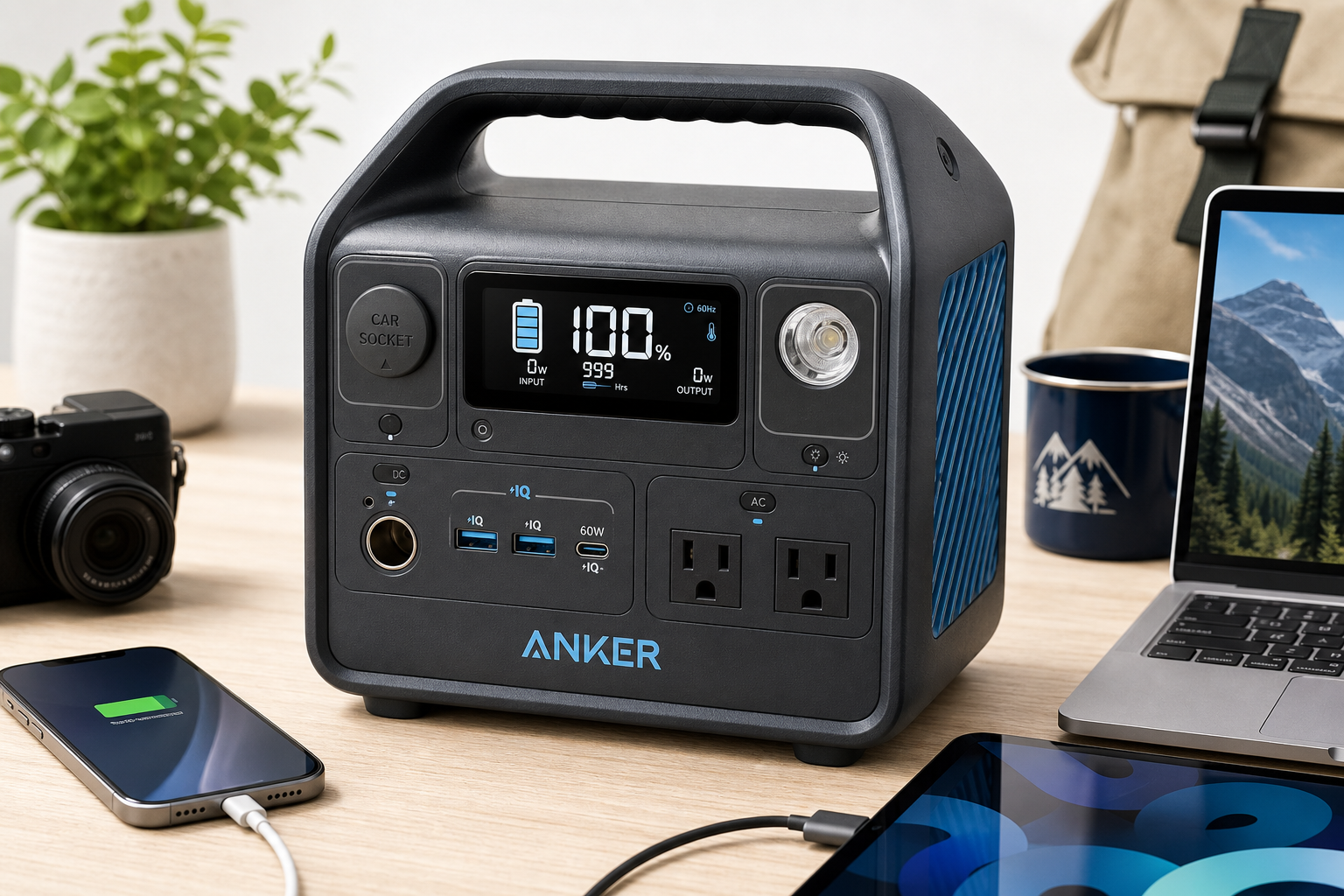
The Anker 521 Portable Power Station Upgraded with LiFePO4 Battery, 256Wh 6-Port Powerhouse, 300W (Peak 600W) Solar Generator, 2 AC Outlets, 60W USB-C PD Output, Outdoor Generator is Anker’s compact entry in the portable power station category. With a 256Wh LiFePO4 battery, 6 total output options, and support for solar charging, it is aimed at users who need dependable, small-scale power for camping, RV trips, outdoor workspaces, and light emergency backup at home.
Unlike larger multi-kilowatt power stations, the Anker 521 emphasizes portability and long cycle life. It targets scenarios such as keeping phones, tablets, cameras, laptops, Wi‑Fi routers, and low‑draw appliances running for several hours, rather than powering whole-house loads or energy-hungry tools.
Feature Breakdown
-
Battery chemistry and capacity
- 256Wh LiFePO4 battery pack (approximately 80,000 mAh at pack voltage). (manuals.plus)
- LiFePO4 chemistry typically supports thousands of cycles with better thermal stability and safety compared with standard NMC lithium-ion cells.
-
Inverter and AC output
- Rated AC output around 200–300W depending on region/version, with surge capability up to 450–600W for short peaks. (device.report)
- Two AC outlets (North American version) for plugging in small appliances, chargers, or networking gear.
-
DC and USB outputs
- 1 × USB‑C Power Delivery port up to 60W for fast charging compatible laptops, tablets, and phones. (manuals.plus)
- 2 × USB‑A ports (up to 12W per port) for legacy devices. (device.report)
- 1 × 12V car-style output (up to 120W) for gear such as coolers or small 12V appliances. (device.report)
-
Charging options
- AC wall charging via included adapter.
- USB‑C PD input up to 60W.
- DC/solar input (11–28V, up to 65W) with MPPT support, allowing use with compatible solar panels (not included). (device.report)
- AC adapter plus USB‑C can be combined for faster recharging.
-
Design and build
- Compact footprint roughly 8.5 × 5.7 × 8.3 inches and weight around 8–9.5 lb depending on region/package. (device.report)
- Integrated carry handle and rubber feet for stability.
- Built‑in LED light/ambient light with multiple modes on some versions for campsite or outage use. (manuals.plus)
- Clear front LCD screen indicating remaining battery percentage, estimated runtime or recharge time, input/output wattage, and temperature warnings. (manuals.plus)
-
Safety and protections
- Battery management system with over‑voltage, over‑current, short‑circuit, and temperature protections. (manuals.plus)
- Power‑saving mode that automatically shuts off low‑load outputs after a period to prevent phantom drain. (nohma.com)
Performance Insights
In real‑world use, the Anker 521 performs best as a small-device and light-appliance power hub.
Powering everyday electronics
With 256Wh of capacity, the unit is well suited for:
- Charging smartphones and tablets multiple times over a weekend trip.
- Running a laptop via the 60W USB‑C PD port for several hours of work or entertainment.
- Keeping a Wi‑Fi router and modem online during short power outages (often several hours, depending on power draw).
The pure sine wave AC output is designed to be safe for sensitive electronics. Users often employ this class of power station for CPAP machines (with appropriate settings and power constraints), network equipment, or camera gear; the 521 can fit into that role as long as wattage stays within its continuous inverter rating.
Handling small appliances
The 200–300W continuous AC capability with 450–600W peak means the 521 can manage many low‑to‑medium‑draw appliances, such as:
- Small fans or LED lamps
- Compact projectors
- Some portable fridges or coolers within its wattage envelope
- Low‑wattage cooking accessories like small kettles or coffee warmers, provided they do not exceed the continuous rating
High‑draw devices like full‑size hair dryers, space heaters, large coffee makers, or most power tools will typically exceed this station’s limits and either fail to start or trigger protection.
Efficiency and runtime realism
As with most portable power stations, the actual usable capacity is slightly lower than the rated 256Wh once you factor in inverter and conversion losses, especially over AC. Real‑world runtimes therefore depend strongly on whether you draw power via AC or DC, and on the exact load:
- DC (USB‑C/USB‑A/12V) loads are more efficient and provide runtimes closer to the full capacity.
- AC loads suffer additional conversion losses, so high continuous AC use drains the battery faster than simple Wh math suggests.
Some user feedback also notes that the runtime estimates on the display can appear conservative under certain loads, reflecting the algorithm used rather than strict capacity data. (reddit.com)
Solar and off‑grid use
With support for up to around 65W of solar input and MPPT tracking, the Anker 521 can top up during the day from a compatible panel. This makes it viable for light off‑grid usage, such as:
- Extending runtimes for a small 12V fridge over a camping weekend.
- Keeping devices charged on road trips without relying solely on vehicle power.
- Maintaining a trickle of energy into the battery in remote locations.
However, at 256Wh, it is not intended for continuous, high‑duty off‑grid living on its own.
Usability
Port layout and controls
All ports and the display are placed on the front for easy access. Dedicated buttons typically control the AC outputs, DC outputs, and LED light, with a separate power‑saving mode toggle on some revisions. The LCD is straightforward, showing:
- Remaining battery percentage
- Estimated runtime or recharge time
- Input and output wattage numbers
- Icons for active ports and any temperature or protection alerts (manuals.plus)
This clear presentation helps users quickly understand whether their loads are within limits or if they need to reduce consumption.
Portability
At roughly 8–9.5 lb with a compact footprint and integrated handle, the Anker 521 is easy to carry one‑handed between rooms, into a car, or around a campsite. It is notably lighter and smaller than larger 1kWh+ stations, which makes it appealing to users who prioritize grab‑and‑go convenience over maximum capacity.
Noise and thermal management
The unit uses an internal cooling fan that typically activates under higher loads or during charging. Noise levels are usually moderate for a device in this class—audible but not overwhelming in a quiet room. LiFePO4 cells also handle thermal stress better than many standard lithium‑ion chemistries, helping the battery remain more stable across temperature swings. (manuals.plus)
Learning curve
Most first‑time portable power station users adapt quickly to the Anker 521’s interface. The main learning points are:
- Understanding that AC loads incur higher losses and will shorten runtime more than DC loads.
- Keeping power‑saving mode enabled when running only small USB or DC loads, to avoid slow phantom drain. (nohma.com)
- Matching connected devices to the station’s wattage limits to avoid overload shut‑offs.
Trade-offs
While the Anker 521 Portable Power Station is strong in portability and longevity, it comes with clear trade‑offs that buyers should weigh.
Pros
- Long-life LiFePO4 battery for thousands of cycles, making it a robust choice for frequent use. (device.report)
- Compact and relatively lightweight design, easy to transport and store. (manuals.plus)
- Balanced port selection with 2 AC outlets, 60W USB‑C PD, USB‑A ports, and a 12V car outlet for diverse devices. (manuals.plus)
- Solar‑ready with MPPT, suitable for light off‑grid or extended camping scenarios. (device.report)
- Clear LCD and power‑saving features that help users monitor and minimize waste. (manuals.plus)
Cons
- Limited AC wattage (around 200–300W continuous) means it cannot handle high‑draw appliances like large kettles, heaters, or power tools. (device.report)
- Modest 256Wh capacity restricts runtime for heavier loads; it is better suited to electronics than to large devices running for many hours. (manuals.plus)
- Single USB‑C port may feel limiting for users with multiple USB‑C laptops or tablets. (manuals.plus)
- Solar input capped around 65W, so recharging from solar alone can take most of a sunny day depending on panel size and conditions. (device.report)
When it may not be the best fit
You may want a different class of power station if:
- You need to power energy‑hungry gear (e.g., 1,500W kettles, space heaters, or large power tools).
- You plan to run a CPAP or fridge for long periods without recharging and require significantly more than 256Wh of capacity.
- You want a whole‑home emergency solution, where multi‑kilowatt‑hour stations or traditional generators are more appropriate.
Conclusion
The Anker 521 Portable Power Station strikes a practical balance between capacity, durability, and portability. Its 256Wh LiFePO4 battery, 60W USB‑C PD port, dual AC outlets, and solar‑charging capability make it a compelling option for:
- Campers and RV travelers who primarily need to keep laptops, phones, cameras, lights, and small appliances powered.
- Home users seeking short‑duration backup for networking gear and essential electronics during brief outages.
- Mobile professionals or creators who want a compact, rechargeable power hub for field work.
It is not designed to run high‑demand appliances or serve as a whole‑home solution, but within its power envelope the Anker 521 delivers reliable performance, simple operation, and the long‑term benefits of LiFePO4 chemistry. For users who prioritize portability, safety, and cycle life over raw capacity, this portable power station is a well‑rounded, thoughtfully engineered choice.